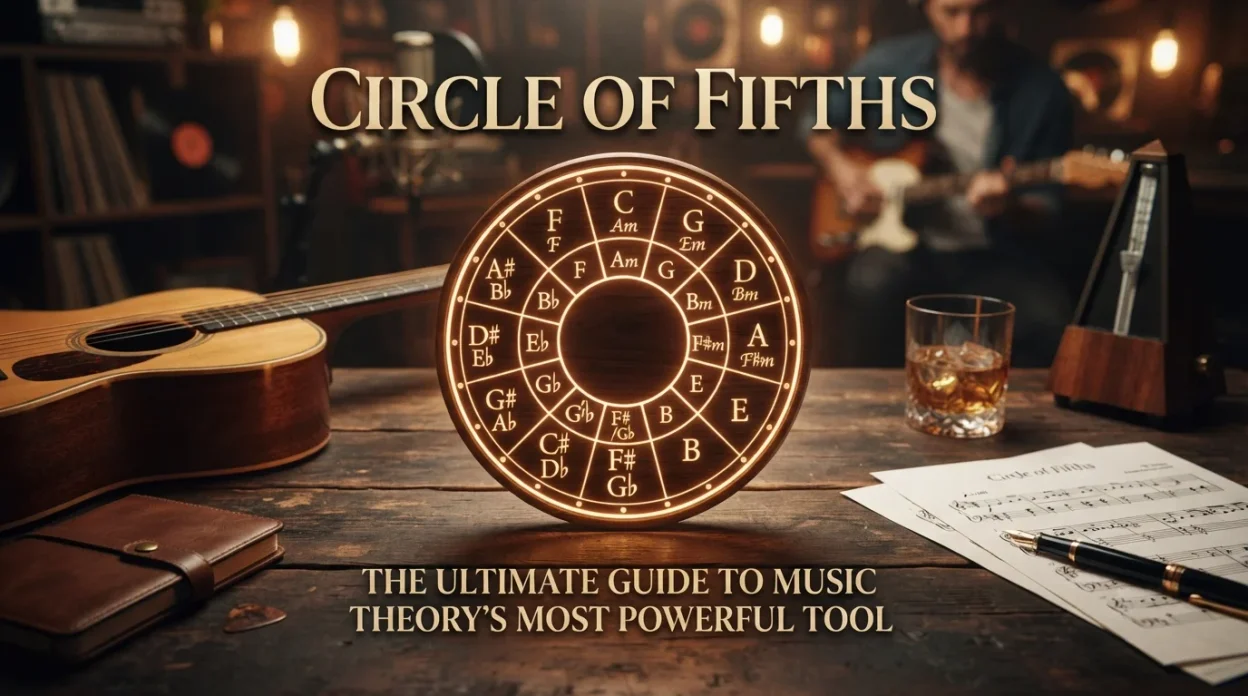
The circle of fifths is a visual diagram that organizes the 12 chromatic pitches in a sequence of perfect fifths. It shows the relationships between major and minor keys, key signatures, and chords. Musicians use it to understand harmony, transpose music, and build chord progressions.
If you have ever stared at a music theory textbook and felt your eyes glaze over, the circle of fifths might seem like another confusing diagram. However, it is actually one of the most practical tools in all of music. Moreover, it unlocks a deeper understanding of how songs work. Let’s break down everything you need to know about this essential concept.
H2: What Is the Circle of Fifths?
The circle of fifths is a way to organize the 12 chromatic pitches as a sequence of perfect fifths . If you start at C and move clockwise, the next note is G, then D, then A, and so on . Each step is a perfect fifth higher than the previous one.
The diagram is usually drawn as a circle. The outer ring shows major keys. The inner ring shows relative minor keys . At the top sits C major, which has no sharps or flats. Moving clockwise, you add one sharp with each step. Moving counterclockwise, you add one flat .
H3: The Basic Structure
A standard circle of fifths contains three main sections :
- The outer ring: Major key centers
- The inner ring: Minor key centers
- Key signatures: The number of sharps or flats in each key
The capital letters on the outside represent major keys. The lowercase letters on the inside represent minor keys . Each major key shares its key signature with a relative minor. For example, C major and A minor both have no sharps or flats.
H2: A Brief History of the Circle of Fifths
The circle of fifths has a long and fascinating history. Its roots stretch back to ancient Greece, but the modern version took shape in the 17th century.
H3: Early Origins
Many people credit Pythagoras with the concept. In the 6th century BCE, he explored the mathematical relationships between musical intervals . He discovered that dividing a vibrating string produces consonant intervals, including the perfect fifth. However, there is little evidence that Pythagoras conceptualized the circle as we know it today .
H3: The First Diagrams
The first known depiction of the circle of fifths appeared in 1677. Ukrainian composer and theorist Nikolay Diletsky included it in his treatise Grammatika . The work was intended as a guide for composition in the Western polyphonic style. Diletsky called it the “wheel of merry music” .
H3: Modern Refinement
In 1728, German composer Johann David Heinichen presented an updated version. His “Musical Circle” further elaborated on key relationships and their practical applications . This version is essentially what we use today.
H2: How to Read the Circle of Fifths
Reading the circle is simpler than it looks. Once you understand the pattern, it becomes a powerful reference tool.
H3: Moving Clockwise: The Sharp Keys
Start at C major at the top of the circle. Moving clockwise, each step adds one sharp to the key signature .
Major KeyNumber of SharpsSharps in the KeyC major0NoneG major1F#D major2F#, C#A major3F#, C#, G#E major4F#, C#, G#, D#B major5F#, C#, G#, D#, A#F# major6F#, C#, G#, D#, A#, E#
The order of sharps is always the same: F, C, G, D, A, E, B . A common mnemonic is “Father Charles Goes Down And Ends Battle” .
H3: Moving Counterclockwise: The Flat Keys
Moving counterclockwise from C major, each step adds one flat .
Major KeyNumber of FlatsFlats in the KeyC major0NoneF major1BbBb major2Bb, EbEb major3Bb, Eb, AbAb major4Bb, Eb, Ab, DbDb major5Bb, Eb, Ab, Db, GbGb major6Bb, Eb, Ab, Db, Gb, Cb
The order of flats is the reverse of the sharps: B, E, A, D, G, C, F . The mnemonic reverses too: “Battle Ends And Down Goes Charles Father” .
H3: The Inner Circle: Minor Keys
Each major key has a relative minor. You find it by counting down three semitones from the major tonic . On the circle, the minor keys are displayed inside the major ring.
Major KeyRelative MinorC majorA minorG majorE minorD majorB minorA majorF# minorF majorD minorBb majorG minor
Relative major and minor keys share the same key signature. This means they use the same set of notes .
H2: Practical Uses of the Circle of Fifths
The circle is not just a theory diagram. It is a working tool that musicians use every day.
H3: Finding Key Signatures
One of the most common uses is identifying how many sharps or flats belong in a key . Instead of memorizing each key separately, you can simply look at its position on the circle. If you see three sharps in a piece of sheet music, you know the key is A major or F# minor.
H3: Building Chord Progressions
The circle explains why certain chord movements sound natural. In tonal music, chords often progress by descending fifths or ascending fourths . This creates a strong sense of resolution.
A common example is the ii–V–I progression used in jazz, pop, and classical harmony. In C major, this becomes D minor, G major, C major . Each chord moves by a fifth relationship, creating forward motion that sounds satisfying.
Other useful patterns include :
- I–V–vi–IV in C: C, G, A minor, F
- vi–IV–I–V in C: A minor, F, C, G
- iii–vi–ii–V–I in C: E minor, A minor, D minor, G, C
H3: Transposing Music
Transposition means moving a song into a different key while keeping the same interval relationships . The circle makes this easy. If you want to move a song from C to G, find C on the circle and find G. G is one step clockwise. Every chord in the song moves one step clockwise.
Original (C)Transposed (G)CGFCGDAmEmDmAm
H3: Understanding Chord Families
The circle shows which chords belong together in a key. For any major key, the most common chords are :
- I (the key itself)
- V (one step clockwise)
- IV (one step counterclockwise)
- vi (the relative minor, on the inner circle)
- ii (two steps clockwise, minor)
For example, in G major, the chord family includes G, D, C, Em, and Am . These chords appear together in thousands of songs.
H2: Circle of Fifths Progression
The circle of fifths also refers to a specific harmonic progression. This progression moves through all the diatonic chords by descending fifths .
H3: The Classic Sequence
In C major, the circle of fifths progression is :
I – IV – vii° – iii – vi – ii – V – I
Which translates to: C – F – Bdim – Em – Am – Dm – G – C
This progression was a staple of the Baroque era. You will find examples in the music of Bach, Handel, and Vivaldi . It creates a feeling of inevitability because it consists of harmonic sequences.
H3: Famous Songs Using the Circle
Many popular songs use circle of fifths progressions. Examples include :
- “All the Things You Are” by Jerome Kern
- “Autumn Leaves” by Kosma, Prevert, and Mercer
- “I Will Survive” by Gloria Gaynor
- “You Never Give Me Your Money” by The Beatles
H2: The Mathematics Behind the Circle
The circle of fifths works because of the mathematical relationship between pitches. A perfect fifth has a frequency ratio of 3:2 in just intonation .
H3: The Pythagorean Comma
Here is where things get interesting. If you stack twelve perfect fifths on top of each other, you do not quite return to the starting note. You end up slightly sharp by an interval called the Pythagorean comma . This is roughly a quarter of a semitone.
H3: Equal Temperament
To make the circle close properly, instruments use equal temperament. In this system, the fifth is slightly flattened from its pure 3:2 ratio . This compromise allows music to be played in any key without sounding out of tune.
The equal-tempered fifth has a frequency ratio of about 1.498307:1, which is approximately two cents narrower than a justly tuned fifth .
H2: Common Mistakes and How to Avoid Them
The circle of fifths is simple, but beginners often make mistakes when first learning it.
H3: Confusing Major and Minor
Remember that the outer ring is major and the inner ring is minor . Major keys sound “happy,” while minor keys sound “sad” . Each major key shares its key signature with a relative minor.
H3: Forgetting the Order of Sharps and Flats
The order never changes. Sharps always appear as F, C, G, D, A, E, B . Flats always appear as B, E, A, D, G, C, F . Memorize these sequences, and the circle becomes much easier.
H3: Mixing Up Clockwise and Counterclockwise
Clockwise adds sharps. Counterclockwise adds flats . If you are looking for a key with flats, move left from C. If you want sharps, move right.
H2: FAQ
What is the circle of fifths in simple terms?
The circle of fifths is a diagram that arranges musical keys in a circle. Each key is a perfect fifth apart. It shows how many sharps or flats each key has and how keys relate to each other .
Who invented the circle of fifths?
The first known depiction appeared in 1677 in a treatise by Ukrainian composer Nikolay Diletsky . German theorist Johann David Heinichen refined it in 1728 .
How do I use the circle of fifths to find chords?
For any major key, the most common chords are the I, IV, V, vi, and ii. On the circle, the IV is one step counterclockwise, the V is one step clockwise, and the vi is the relative minor on the inner ring .
What is the circle of fifths progression?
It is a chord progression that moves by descending fifths through the diatonic chords. In C major, it is C – F – Bdim – Em – Am – Dm – G – C . This progression was common in Baroque music.
Why does the circle of fifths have 12 keys?
Western music divides the octave into 12 equal semitones. Each semitone can be the root of a major or minor key, giving 12 major keys and 12 minor keys .
Can I use the circle of fifths for guitar?
Absolutely. The circle maps directly to the fretboard. Moving up 7 frets on a single string equals one step clockwise on the circle .
H2: Conclusion
The circle of fifths is one of the most powerful tools in music theory. It organizes all 12 keys in a way that reveals their relationships. Moreover, it helps musicians find key signatures, build chord progressions, and transpose songs.
From its origins in 17th-century Ukraine to its use in modern pop and jazz, the circle has stood the test of time. It is a map of musical harmony that every musician should know.
Whether you are a beginner learning your first scales or a seasoned songwriter looking for new ideas, the circle of fifths will serve you well. Keep it nearby. Use it often. And watch as music theory starts to make sense.

hwuduwgdul