
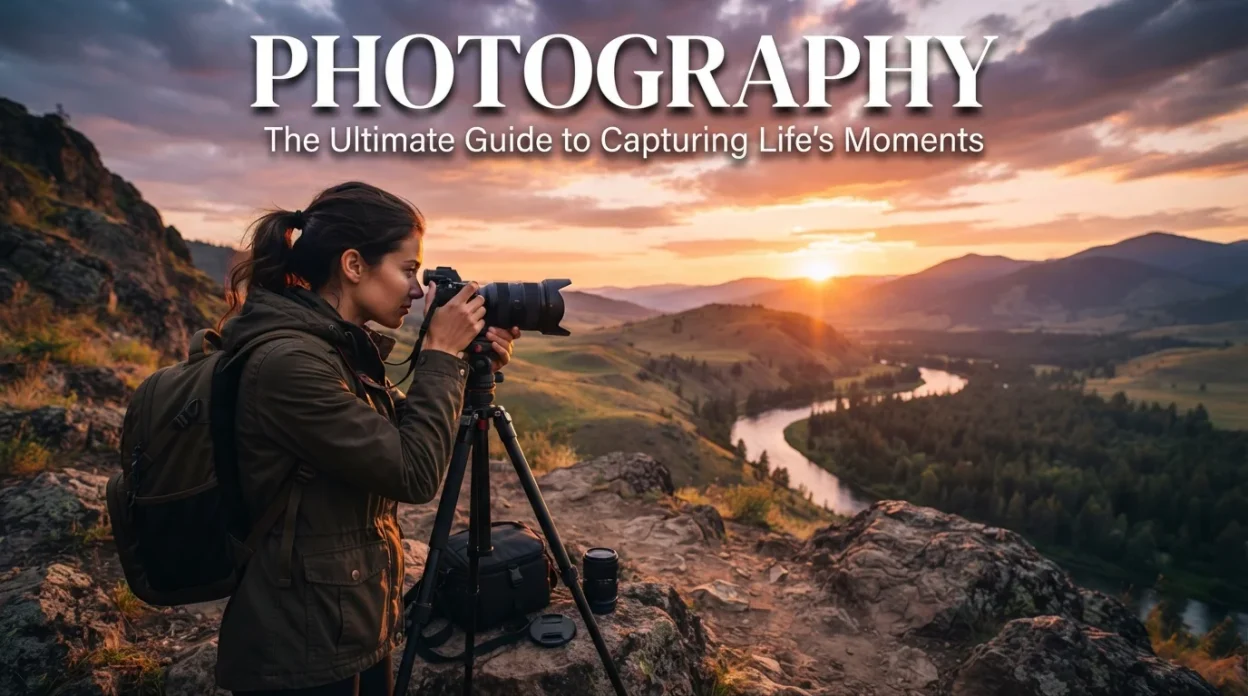
Photography is the art and science of capturing light to create images. It involves using a camera to record scenes, people, and moments. Photography allows us to freeze time, tell stories, and express emotions without words.
If you have ever looked at a photograph and felt something—joy, nostalgia, wonder—you already understand the power of photography. It is more than just pointing a camera and pressing a button. It is a craft that combines technical skill with artistic vision. Moreover, it is a skill that anyone can learn and improve. Let’s explore everything you need to know about this incredible medium.
H2: What Is Photography?
Photography is the process of recording images by capturing light on a light-sensitive surface. The word “photography” comes from the Greek words phos (light) and graphê (drawing). Together, they mean “drawing with light.”
A camera works by letting light pass through a lens. The lens focuses the light onto a sensor or film. This creates a permanent image of whatever was in front of the camera. Modern digital cameras do this instantly. Older film cameras required chemical processing to reveal the image.
H3: The Two Main Types of Photography
TypeHow It WorksDigital PhotographyUses an electronic sensor to capture images. Images are stored as digital files.Film PhotographyUses light-sensitive film to capture images. Images are developed with chemicals.
Digital photography has become the standard for most photographers. However, film photography has experienced a resurgence in recent years. Many artists prefer the unique look and feel of film.
H2: A Brief History of Photography
Photography has a rich and fascinating history. It evolved over centuries through the work of scientists, artists, and inventors.
H3: The Earliest Beginnings
The concept of photography dates back to ancient times. The Chinese philosopher Mozi described the principles of the camera obscura in the 5th century BCE. This was a dark room or box with a small hole that projected an inverted image of the outside world onto a surface.
H3: The First Photographs
The first permanent photograph was created in 1826 by French inventor Nicéphore Niépce. He used a process called heliography. The exposure took eight hours.
In 1839, Louis Daguerre introduced the daguerreotype. This was the first commercially successful photographic process. It produced sharp, detailed images on silver-coated copper plates.
H3: The Rise of Roll Film
In 1888, George Eastman founded Kodak. He introduced roll film and the first portable camera. This made photography accessible to the general public. Suddenly, anyone could take photos.
H3: The Digital Revolution
The first digital camera was invented in 1975 by Steven Sasson at Kodak. It weighed eight pounds and recorded images onto a cassette tape. By the 2000s, digital cameras had replaced film for most consumers. Then, smartphones arrived. Today, billions of people carry a camera in their pocket.
H2: Essential Photography Equipment
You do not need expensive gear to take great photos. However, understanding your equipment helps you improve. Here are the essential tools.
H3: The Camera
There are several types of cameras:
- DSLR: Digital Single-Lens Reflex. These cameras have interchangeable lenses and manual controls. They are popular with professionals.
- Mirrorless: Similar to DSLRs but without a mirror. They are lighter and more compact.
- Point-and-Shoot: Simple cameras with fixed lenses. Great for beginners.
- Smartphone: The most accessible camera. Modern phones take excellent photos.
H3: Lenses
The lens is one of the most important factors in image quality.
- Wide-Angle Lens: Good for landscapes and architecture.
- Telephoto Lens: Good for sports, wildlife, and portraits.
- Macro Lens: Good for close-up shots of small subjects.
- Prime Lens: A lens with a fixed focal length. It offers sharp images and wide apertures.
H3: Accessories
- Tripod: Keeps your camera steady for sharp images.
- Filters: Control light and color.
- Memory Cards: Store your images.
- Extra Batteries: Always carry spares.
- Camera Bag: Protects your gear.
H2: The Exposure Triangle
Understanding exposure is the foundation of photography. Three settings control how much light reaches your camera’s sensor. Together, they form the exposure triangle.
H3: Aperture
Aperture is the size of the opening in your lens. It is measured in f-stops.
- Low f-stop (e.g., f/1.8): Large opening. Lets in more light. Creates a shallow depth of field (blurry background).
- High f-stop (e.g., f/16): Small opening. Lets in less light. Creates a deep depth of field (everything in focus).
H3: Shutter Speed
Shutter speed is how long your camera’s sensor is exposed to light.
- Fast shutter speed (e.g., 1/1000s): Freezes motion. Good for sports.
- Slow shutter speed (e.g., 1/30s): Blurs motion. Good for artistic effects. Requires a tripod.
H3: ISO
ISO measures your camera’s sensitivity to light.
- Low ISO (e.g., 100): Less sensitive. Best for bright conditions. Produces cleaner images.
- High ISO (e.g., 3200): More sensitive. Best for low light. May introduce noise.
SettingControlsLow ValueHigh ValueApertureLight & Depth of FieldLarge opening, blurry backgroundSmall opening, sharp backgroundShutter SpeedLight & MotionFreezes motionBlurs motionISOLight SensitivityClean imageNoisy image
H2: Types of Photography
Photography covers many genres. Each has its own techniques and goals.
H3: Portrait Photography
Portrait photography captures people. It focuses on faces, expressions, and personality. Good portraits make the viewer feel connected to the subject.
Tips:
- Use natural light when possible.
- Focus on the eyes.
- Use a wide aperture for a blurry background.
H3: Landscape Photography
Landscape photography captures nature and scenery. It showcases mountains, oceans, forests, and cities.
Tips:
- Use a tripod for sharp images.
- Shoot during golden hour (early morning or late afternoon).
- Use a wide-angle lens.
H3: Street Photography
Street photography captures candid moments in public places. It tells stories about everyday life.
Tips:
- Be patient and observant.
- Respect people’s privacy.
- Look for interesting light and shadows.
H3: Wildlife Photography
Wildlife photography captures animals in their natural habitats. It requires patience and specialized equipment.
Tips:
- Use a telephoto lens.
- Learn about animal behavior.
- Be patient. Wait for the perfect moment.
H3: Macro Photography
Macro photography captures extreme close-ups of small subjects. Think insects, flowers, and water droplets.
Tips:
- Use a macro lens.
- Use a tripod for stability.
- Pay attention to lighting.
H3: Sports Photography
Sports photography captures athletes in action. It freezes fast motion and captures peak moments.
Tips:
- Use a fast shutter speed.
- Use continuous autofocus.
- Anticipate the action.
H2: Composition Techniques for Better Photos
Composition is how you arrange elements in your frame. Good composition makes photos more engaging.
H3: The Rule of Thirds
Divide your frame into a 3×3 grid. Place your subject on one of the lines or intersections. This creates balance and visual interest.
H3: Leading Lines
Use lines in your scene to guide the viewer’s eye. Roads, fences, and rivers work well.
H3: Framing
Use objects in the foreground to frame your subject. Windows, arches, and branches are common frames.
H3: Symmetry and Patterns
Symmetrical scenes are pleasing to the eye. Patterns create rhythm. Break the pattern for added impact.
H3: Depth
Create depth by including foreground, middle ground, and background elements. This makes images feel three-dimensional.
H3: Negative Space
Leave empty space around your subject. This draws attention and creates a clean, minimalist look.
H2: Lighting in Photography
Light is the most important element in photography. Without light, there is no photograph.
H3: Natural Light
The sun is the most powerful light source. It changes throughout the day.
- Golden Hour: The hour after sunrise and before sunset. Warm, soft light. Perfect for portraits and landscapes.
- Blue Hour: The hour before sunrise and after sunset. Cool, moody light.
- Midday: Harsh, direct light. Creates strong shadows. Often unflattering for portraits.
H3: Artificial Light
Artificial light gives you control.
- Continuous Light: Always on. Good for beginners.
- Strobe/Flash: Brief burst of light. Good for freezing motion.
H3: The Direction of Light
- Front Light: Illuminates the subject evenly. Can look flat.
- Side Light: Creates texture and depth.
- Back Light: Creates silhouettes and highlights.
- Top Light: Creates dramatic shadows.
H2: Editing Your Photos
Editing is part of the creative process. It enhances your images and brings your vision to life.
- Exposure: Brightness of the image.
- Contrast: Difference between light and dark areas.
- Highlights: Bright areas.
- Shadows: Dark areas.
- White Balance: Color temperature.
- Saturation: Intensity of colors.
- Sharpness: Clarity of details.
- Adobe Lightroom: Industry standard for photo editing.
- Adobe Photoshop: Advanced editing and compositing.
- Capture One: Professional-grade editing.
- Snapseed: Free mobile editing app.
- VSCO: Popular for filters and presets.
Photojournalism and documentary photography have strict ethical rules. Manipulating images can mislead viewers. However, artistic photography allows creative freedom.
H2: Photography Tips for Beginners
Starting photography can feel overwhelming. Here are some simple tips to get you going.
- Learn your camera. Read the manual. Practice with different settings.
- Shoot every day. The more you shoot, the better you get.
- Study other photographers. Look at their work. Analyze what makes it great.
- Focus on light. Great light makes great photos.
- Master composition. Use the rule of thirds. Look for leading lines.
- Don’t chase gear. A good photographer with a basic camera beats a bad photographer with expensive gear.
- Edit your photos. Editing is part of the process.
- Get feedback. Share your work. Learn from criticism.
- Develop your style. Find what you love to shoot.
- Be patient. Photography is a journey.
H2: FAQ
What is photography in simple words?
Photography is the art of capturing images using a camera. It records light to create pictures of people, places, and moments.
What are the three basic settings in photography?
The three basic settings are aperture, shutter speed, and ISO. Together, they control how much light reaches your camera’s sensor.
What is the rule of thirds?
The rule of thirds is a composition technique. You divide your frame into a 3×3 grid. Then you place your subject on one of the lines or intersections.
What is the best camera for beginners?
The best camera is the one you have. Smartphones work great for learning. If you want a dedicated camera, a mirrorless or entry-level DSLR is a good choice.
What is golden hour in photography?
Golden hour is the hour after sunrise and before sunset. The light is warm, soft, and flattering. It is perfect for portraits and landscapes.
How do I improve my photography skills?
Practice every day. Study light and composition. Learn from other photographers. Edit your photos. And most importantly, keep shooting.
H2: Conclusion
Photography is a beautiful blend of art and science. It allows you to capture moments, tell stories, and express your unique vision. Whether you use a smartphone or a professional camera, the principles remain the same.
Start by learning the basics: exposure, composition, and light. Practice consistently. Develop your style. And remember, the best camera is the one you have with you.
So go out there. Look at the world through a lens. Capture what moves you. Photography is not just about taking pictures. It is about seeing the world in a new way.

hwuduwgdul