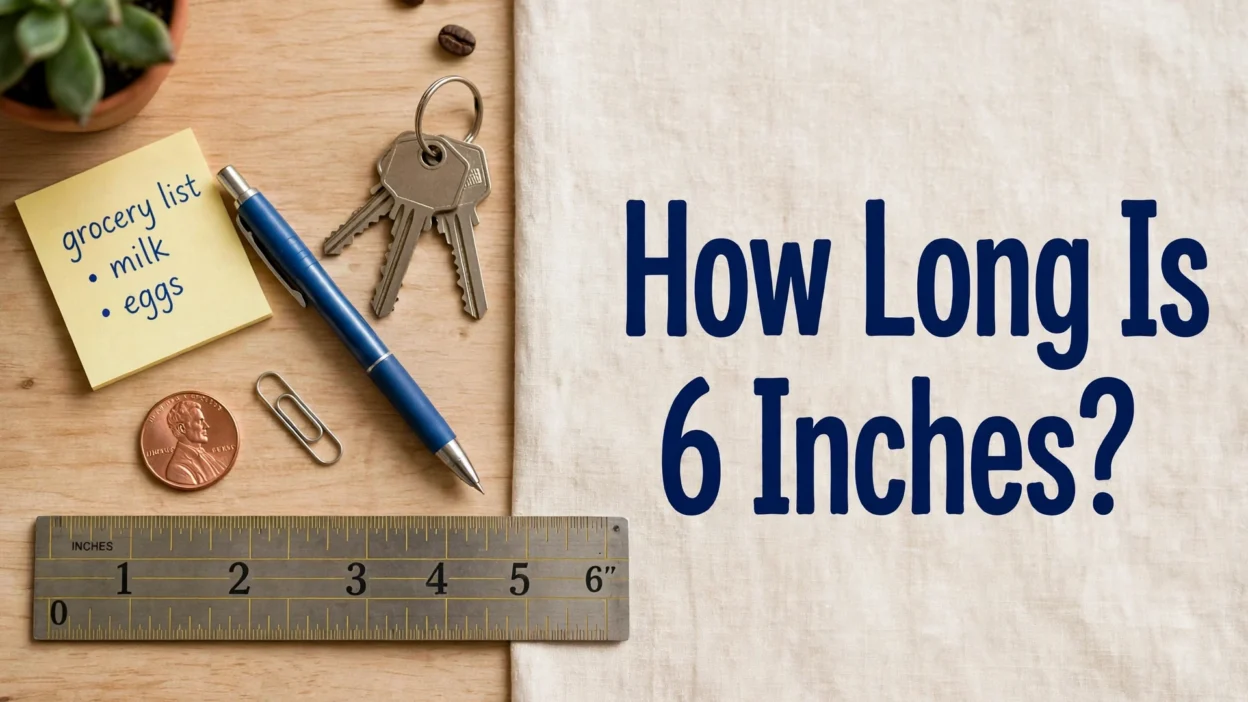
Six inches is a common length used to describe everyday objects, household items, school supplies, and small tools. Whether you are measuring something for a DIY project, comparing the size of an object, or trying to estimate a length without a ruler, understanding this measurement can make everyday tasks easier.
Exactly 6 inches equals 15.24 cm, 152.4 mm, 0.5 ft, and 0.1524 m. It is half a foot, making it a convenient reference point when working with inches and feet. Although six inches may sound short, it is a useful length for many practical purposes, from estimating the width of a small notebook to checking the approximate size of a kitchen utensil.
In this guide, you will learn how long six inches is, how to convert it into different measurement units, and how to recognize this length using familiar everyday objects. You will also discover practical methods for estimating the measurement without a ruler and find answers to common questions about six inches.
How Long Is 6 Inches?
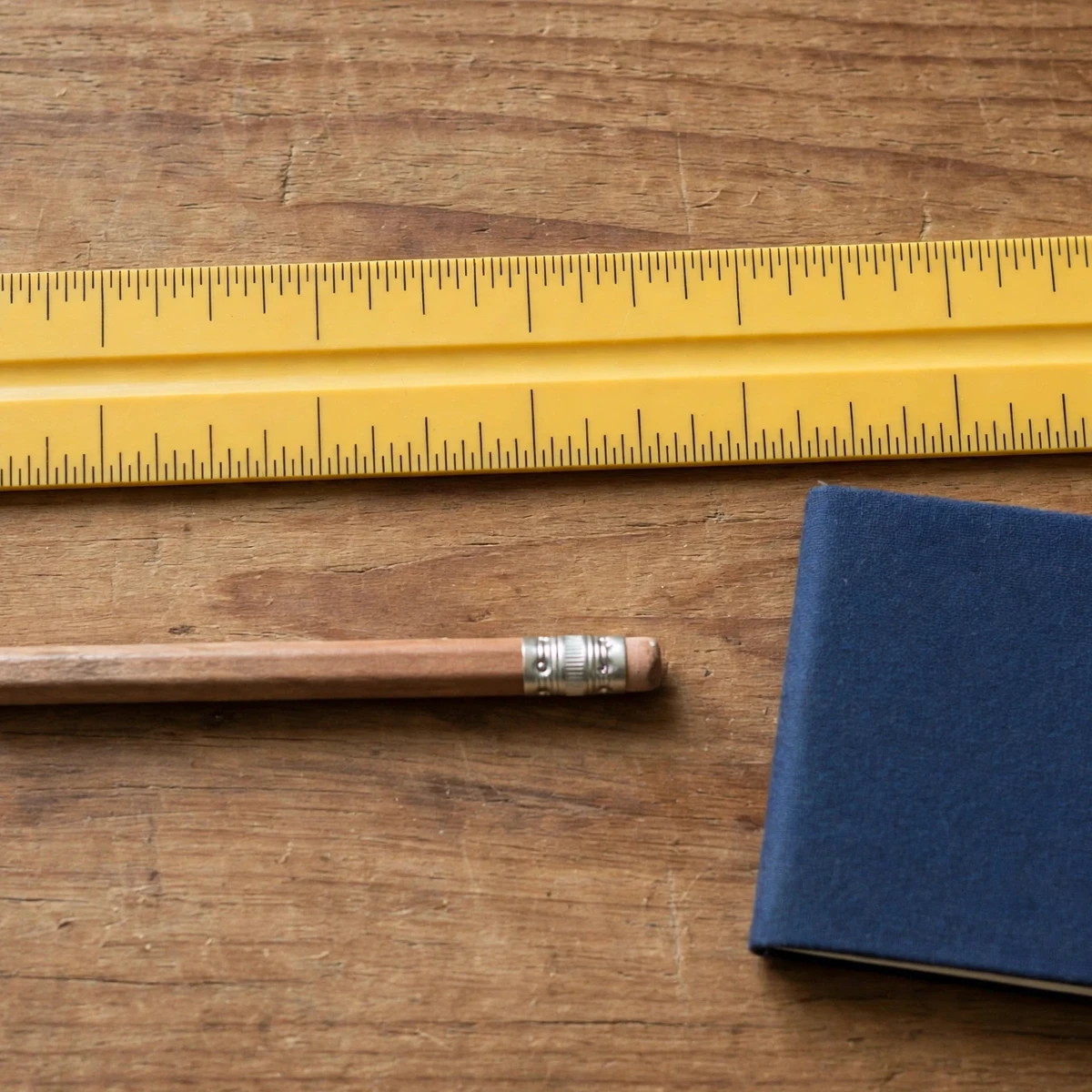
Six inches is a length of 15.24 centimeters. In everyday terms, it is approximately the length of a short pencil, the height of a compact notebook, or the length of a small household item.
The exact size of an object depends on its design, but these familiar comparisons can help you picture the measurement more easily.
An inch is a unit of length commonly used in the United States. There are 12 inches in one foot, so six inches represents exactly half a foot. If you imagine dividing a one-foot ruler into two equal sections, each section measures six inches.
Another way to understand the length is to compare it with a centimeter ruler. Six inches extends slightly beyond the 15-centimeter mark because the exact metric equivalent is 15.24 centimeters.
This difference matters when precision is important. For example, an object that measures exactly six inches is not precisely 15 centimeters long. The difference is 0.24 centimeters, or 2.4 millimeters.
Six inches is also equal to 152.4 millimeters. Millimeters are particularly useful when measuring small parts, crafting materials, electronic components, and other objects that require greater precision.
In meters, six inches equals 0.1524 meters. Although this number may look more complicated, it represents the same physical length.
For practical purposes, six inches can be visualized as a relatively short distance that fits comfortably across a person’s hand or along a small household item. However, hand sizes and everyday objects differ, so these comparisons are best used for estimation rather than exact measurement.
Understanding the length becomes much easier when you connect it to objects you already know. Once you recognize a few reliable examples, you can estimate six inches in many situations without needing to perform a conversion every time.
6 Inches Conversion Chart
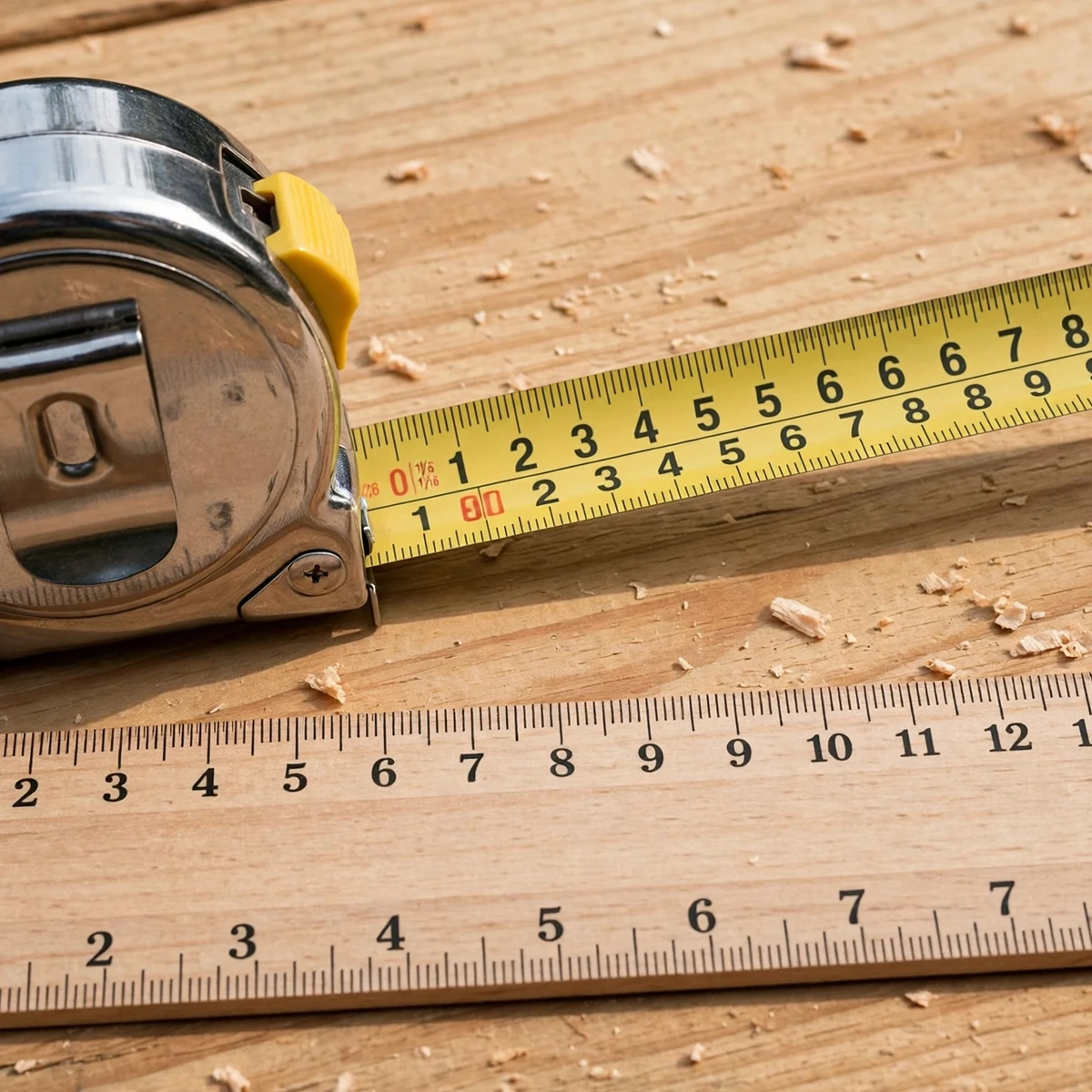
A conversion chart makes it easier to compare inches with feet, centimeters, millimeters, meters, and yards. The table below includes measurements from half an inch through 12 inches, allowing you to see how the values change as the length increases.
The values are calculated using standard length conversions. Metric values are shown to four decimal places where appropriate, while larger units are rounded for readability.
| Inches | Feet | Centimeters | Millimeters | Metres | Yards |
|---|---|---|---|---|---|
| 0.5 | 0.0417 | 1.27 | 12.7 | 0.0127 | 0.0139 |
| 1 | 0.0833 | 2.54 | 25.4 | 0.0254 | 0.0278 |
| 2 | 0.1667 | 5.08 | 50.8 | 0.0508 | 0.0556 |
| 3 | 0.25 | 7.62 | 76.2 | 0.0762 | 0.0833 |
| 4 | 0.3333 | 10.16 | 101.6 | 0.1016 | 0.1111 |
| 5 | 0.4167 | 12.7 | 127 | 0.127 | 0.1389 |
| 6 | 0.5 | 15.24 | 152.4 | 0.1524 | 0.1667 |
| 7 | 0.5833 | 17.78 | 177.8 | 0.1778 | 0.1944 |
| 8 | 0.6667 | 20.32 | 203.2 | 0.2032 | 0.2222 |
| 9 | 0.75 | 22.86 | 228.6 | 0.2286 | 0.25 |
| 10 | 0.8333 | 25.4 | 254 | 0.254 | 0.2778 |
| 11 | 0.9167 | 27.94 | 279.4 | 0.2794 | 0.3056 |
| 12 | 1 | 30.48 | 304.8 | 0.3048 | 0.3333 |
The most important row is the six-inch measurement. It shows that six inches equals half a foot, 15.24 centimeters, 152.4 millimeters, 0.1524 meters, and approximately 0.1667 yards.
You can also use the chart to compare nearby lengths. For instance, five inches equals 12.7 centimeters, while seven inches equals 17.78 centimeters. That means a six-inch object is 2.54 centimeters longer than a five-inch object and 2.54 centimeters shorter than a seven-inch object.
These differences are useful when estimating the dimensions of objects, choosing materials, or deciding whether something will fit into a particular space.
Simple Conversion Formulas
You do not need to memorize every value in the chart. A few simple formulas will allow you to convert six inches or almost any other measurement into the units you need.
- Inches to centimeters – Multiply by 2.54. Formula: Inches x 2.54 = Centimeters. For six inches: 6 x 2.54 = 15.24 cm
- Inches to millimeters – Multiply by 25.4. Formula: Inches x 25.4 = Millimeters. For six inches: 6 x 25.4 = 152.4 mm
- Inches to feet – Divide by 12. Formula: Inches / 12 = Feet. For six inches: 6 / 12 = 0.5 ft
- Inches to meters – Multiply by 0.0254. Formula: Inches x 0.0254 = Meters. For six inches: 6 x 0.0254 = 0.1524 m
- Inches to yards – Divide by 36. Formula: Inches / 36 = Yards. For six inches: 6 / 36 = 0.1667 yards, approximately.
- Centimeters to inches – Divide by 2.54. Formula: Centimeters / 2.54 = Inches. For example: 15.24 / 2.54 = 6 inches.
These formulas work because the relationships between these units are fixed. Once you understand them, converting measurements becomes a straightforward calculation rather than a guessing game.
Everyday Objects That Are Around 6 Inches
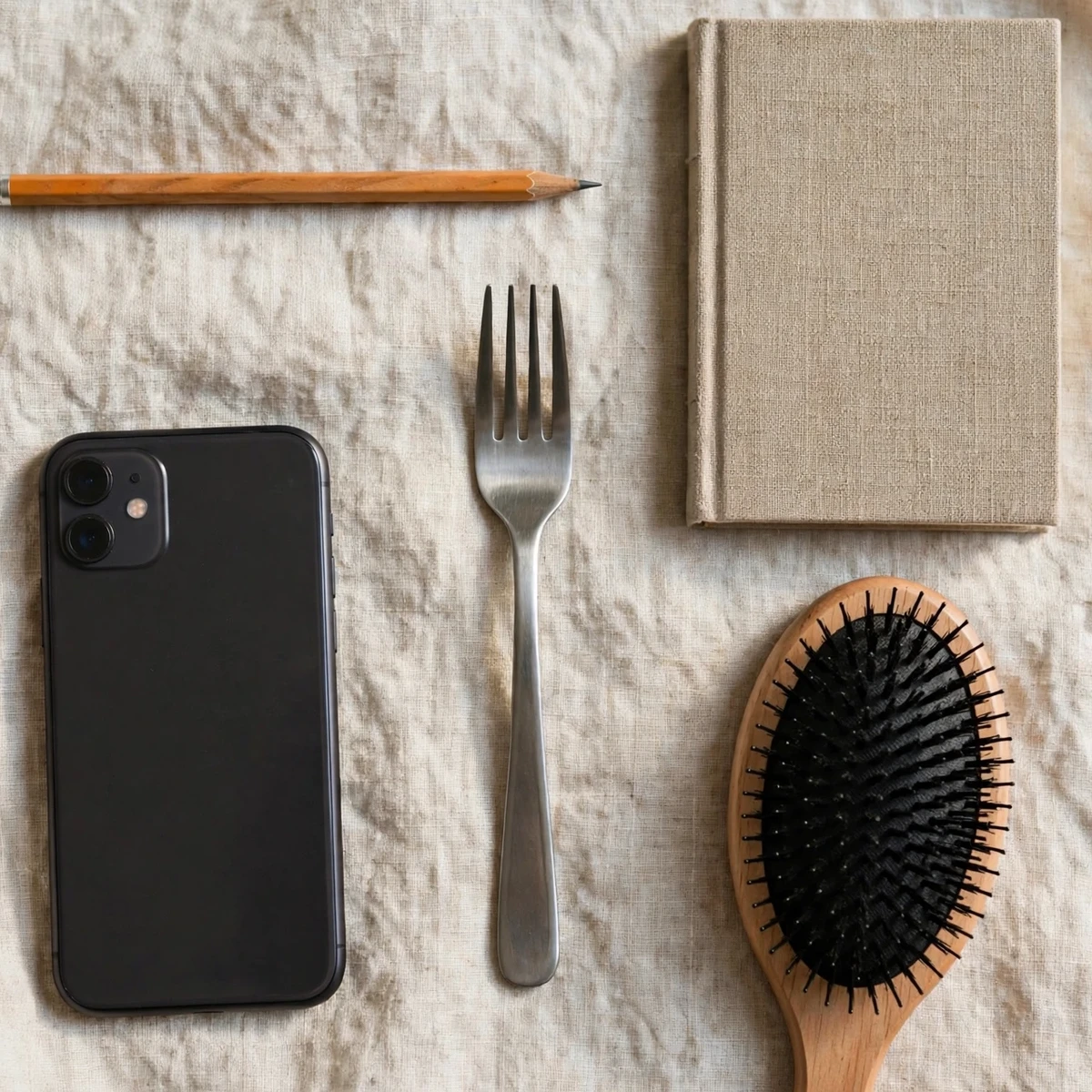
One of the easiest ways to understand six inches is to compare it with objects you encounter regularly. You might not always have a measuring tape nearby, but you can often find something with a similar length in your home, office, classroom, or kitchen.
Everyday objects are useful visual references because you already have a general idea of their size. A small notebook, a compact utensil, or a personal-care item may help you estimate the distance without calculating centimeters or millimeters.
However, it is important to distinguish between an approximate comparison and an exact measurement. Two objects that look similar can have different dimensions, even when they serve the same purpose.
For example, a short pencil may be close to six inches long, but a newly purchased pencil is often longer. Similarly, a small notebook might measure approximately six inches along one side, while another notebook of the same general type could be noticeably wider or taller.
The following examples will help you develop a more practical sense of this length. Some objects are useful because their length is close to six inches, while others can serve as convenient references for estimating the distance.
When using these comparisons, pay attention to which dimension you are measuring. An object might be six inches long but only two inches wide. Its overall size alone does not tell you whether any particular side measures six inches.
10 Everyday Objects That Measure Around 6 Inches
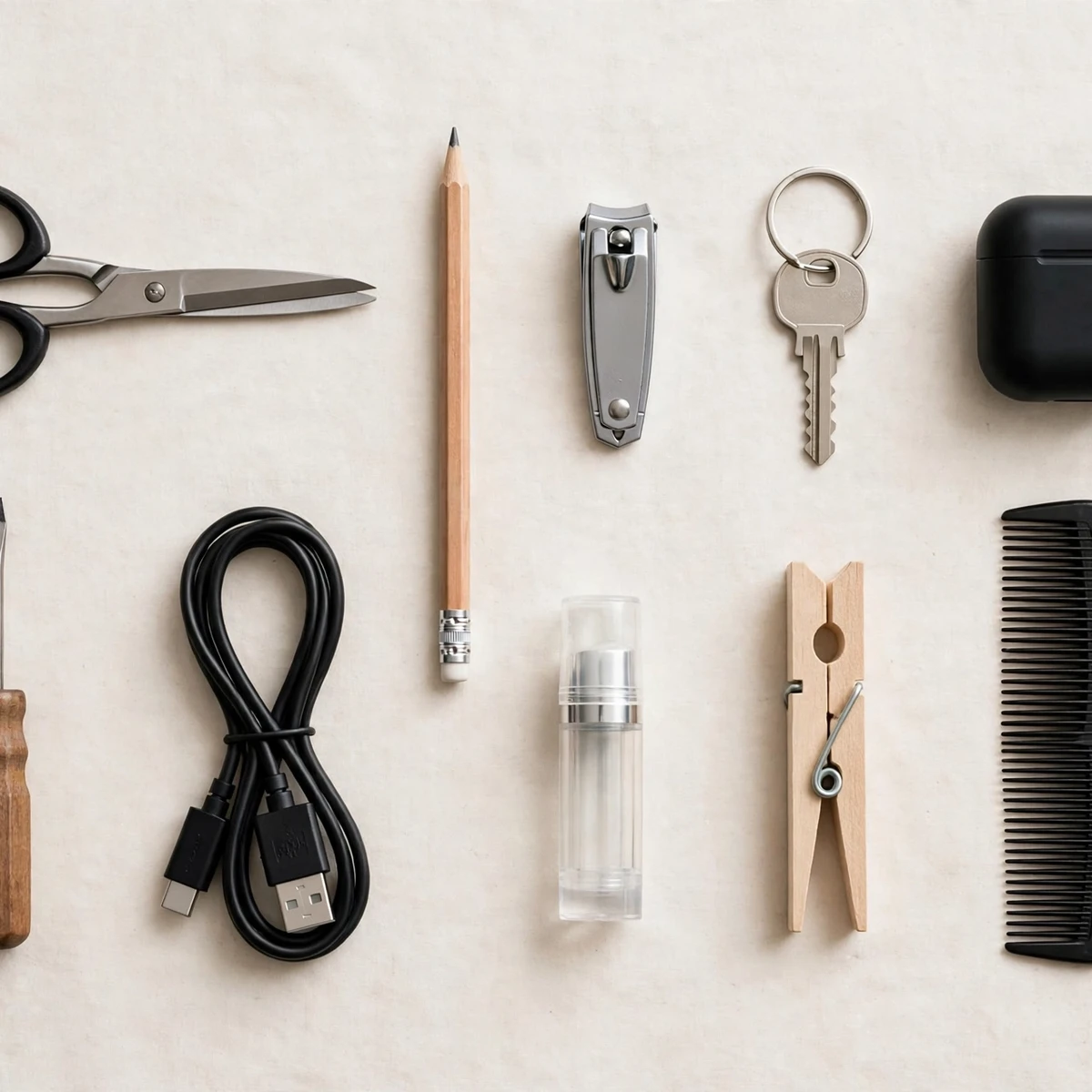
The following ten objects provide familiar ways to visualize a length of approximately six inches. Their measurements are illustrative rather than universal, so check the actual dimensions when accuracy matters.
1. A Short Pencil
A pencil is one of the most recognizable objects to use when estimating length. A shortened pencil, particularly one that has been used for a while, may measure close to six inches from its tip to the opposite end.
Standard pencils are often longer when new, so a full-length pencil should not automatically be treated as an exact six-inch reference. Sharpening also changes the pencil’s overall length over time.
To use a pencil for comparison, measure it once with a ruler. If its length is close to six inches, you can remember that dimension for future estimates.
This is particularly useful for students, artists, and anyone who regularly works with stationery.
Size note: Pencil lengths vary by brand, model, and type, including mechanical pencils, short pencils, and standard wooden pencils.
2. A Small Notebook
A compact notebook is another useful reference because one of its sides may measure around six inches. Some pocket notebooks are designed to fit into a small bag or jacket pocket, making them convenient examples of relatively short lengths.
When comparing a notebook with six inches, identify whether you are measuring its height or width. A notebook might be six inches tall while its width is considerably smaller.
You can also compare the notebook’s longest side with half a foot to develop a better visual estimate.
Small notebooks are useful references in offices, classrooms, and homes because they are easy to handle and commonly available.
Size note: Notebook dimensions vary by brand, model, format, and type. Always check the listed height and width before treating a notebook as a six-inch reference.
3. A Dinner Fork
A dinner fork can help you picture a six-inch measurement, particularly if you have a compact fork in your kitchen drawer. Some forks are close to this length, although many full-size dinner forks are longer.
The easiest way to use a fork as a reference is to measure it from the tip of the handle to the end of the longest tine. This gives you its overall length rather than the length of the handle alone.
Once you know how long your fork is, you can compare it with other household objects.
Kitchen utensils can be particularly convenient because they have relatively straight shapes that make visual comparisons easier.
Size note: Fork dimensions vary by brand, model, and type, including salad forks, dinner forks, dessert forks, and children’s utensils.
4. A Smartphone
A smartphone is a familiar object that can help you estimate six inches, but its exact dimensions depend on the device. Some compact phones have a height close to six inches, while many larger smartphones exceed that length.
For this comparison, focus on the phone’s physical height rather than the diagonal measurement commonly used to describe screen size.
Screen size and overall phone length are not the same. A phone advertised with a six-inch display may measure more than six inches from its top edge to its bottom edge because the display is measured diagonally.
If your phone is close to six inches tall, it can become a convenient reference when you need a quick estimate.
Size note: Smartphone dimensions vary by brand, model, screen design, and type. Cases can also increase the phone’s overall size.
5. A Small Hairbrush
A compact hairbrush may measure around six inches from the end of its handle to the opposite edge of its head. Travel brushes are especially useful examples because they are designed to fit into handbags, toiletry bags, or small luggage compartments.
The length of a brush is easy to visualize because it generally forms a clear line from one end to the other. This makes it a convenient object for comparing lengths.
Some small brushes are slightly shorter than six inches, while others are longer. The shape of the brush head can also make it difficult to estimate the length accurately by sight alone.
Nevertheless, a compact hairbrush can provide a useful mental picture of a six-inch object.
Size note: Hairbrush dimensions vary by brand, model, and type, including travel brushes, paddle brushes, round brushes, and children’s brushes.
6. A Butter Knife
A butter knife is another kitchen item that may help you visualize a length close to six inches. Some smaller butter knives have an overall length near this measurement, although many conventional table knives are longer.
Measure the entire utensil from the tip of its handle to the opposite end of its blade. Measuring only the blade will give you a shorter result.
Because a butter knife has a relatively straight shape, it is easy to place beside a ruler and compare its dimensions with a six-inch mark.
This example is particularly useful when you are estimating measurements in a kitchen and do not have a measuring tool immediately available.
Size note: Butter knife dimensions vary by brand, model, and type, including spreader knives, individual table knives, and specialty utensils.
7. A Small TV or Monitor Remote
A compact television remote control may be approximately six inches long. Remote controls are commonly rectangular, so their longest dimension provides a straightforward reference for comparing lengths.
Place the remote beside an object you want to measure and compare their longest sides. If the remote is close to six inches, an object of similar length will probably be in the same general range.
However, some remote controls are considerably longer, especially those with many buttons or dedicated controls for additional devices.
The remote’s width is also much smaller than its length, so make sure you compare the correct side.
Size note: Remote control dimensions vary by brand, model, and type, including television remotes, streaming-device remotes, and universal remotes.
8. A Compact Hair Comb
A pocket comb is a convenient example of a small everyday object that may measure close to six inches. Its narrow, elongated shape makes it easy to compare with other objects when estimating length.
Some combs are designed specifically for travel, while others are intended for home use or professional styling. Their overall dimensions can differ substantially.
To estimate six inches using a comb, compare the full length from one end to the other. Do not confuse the length of the teeth with the length of the entire comb.
A compact comb is particularly useful as a reference because its straight edges make the overall dimension relatively easy to judge.
Size note: Comb dimensions vary by brand, model, and type, including pocket combs, styling combs, wide-tooth combs, and fine-tooth combs.
9. A Small Kitchen Spatula
A small kitchen spatula can provide another comparison for a six-inch measurement. Some miniature spatulas and baking utensils are short enough to fall near this range, especially when designed for small containers or individual portions.
The handle usually accounts for much of the overall length, while the flexible head adds to the utensil’s total dimension.
A compact spatula can be a useful reference when preparing food, organizing kitchen equipment, or estimating the size of a small storage compartment.
It is worth remembering that many full-size cooking spatulas are considerably longer than six inches, so the specific utensil matters.
Size note: Spatula dimensions vary by brand, model, and type, including miniature spatulas, silicone scrapers, baking spatulas, and full-size cooking utensils.
10. A Small Cosmetic Tube
Some compact cosmetic tubes, including certain hand-cream and skincare packages, have a height close to six inches. Their small size makes them useful for visualizing short measurements, particularly when comparing travel-sized personal-care products.
When using a tube as a reference, measure from its bottom edge to its highest point. If the cap is included, make sure you use the same approach whenever you compare it with another object.
Packaging can be misleading because tubes may have flexible bodies, angled caps, or unusual shapes. Two products with similar capacities can have very different heights.
A cosmetic tube can therefore be a convenient reference, but it should not be treated as an exact standard without checking its dimensions.
Size note: Cosmetic packaging varies by brand, model, product capacity, and type. A tube that appears close to six inches may be shorter or longer when measured.
How to Estimate 6 Inches Without a Ruler

You do not always need a ruler or measuring tape to estimate a six-inch length. Familiar objects, simple hand-based comparisons, and basic mental calculations can help you make a reasonable estimate.
These techniques are especially useful when shopping, organizing a room, completing a craft project, or checking whether a small object might fit into a particular space.
Keep in mind that estimating is different from measuring. If you need an accurate dimension for cutting materials, assembling furniture, or completing a technical project, use a proper measuring tool whenever possible.
Method 1: Use Half a Foot as Your Reference
The easiest way to remember six inches is to remember that it equals half a foot.
A standard foot contains 12 inches. Divide that length into two equal parts, and each part measures six inches.
If you have previously used a foot-long ruler, picture its midpoint. The distance from either end to that midpoint is six inches.
You can apply this idea to any object that is approximately one foot long. Half of its length will be approximately six inches.
This technique is useful because it does not require you to remember a complicated conversion. You only need to visualize a foot and divide it into two equal sections.
Method 2: Use Your Hand as a Guide
Your hand can provide a convenient reference when a ruler is unavailable. Depending on your hand size, the distance across your palm or from the base of your palm toward your fingertips may help you visualize a six-inch length.
However, hand measurements differ considerably between individuals. The width of one person’s palm may be noticeably different from another person’s.
For a more reliable estimate, measure your hand once with a ruler and remember the result. If the distance between two points on your hand is close to six inches, you can use those points as a personal reference.
For example, you might discover that the distance from the base of your palm to the tip of your middle finger is close to six inches. This will not be true for everyone, but it can be useful once you know your own measurement.
Avoid assuming that every hand-based estimate is accurate enough for precise work.
Method 3: Compare the Object With a Smartphone
If you have a smartphone nearby, you can use its physical dimensions as a reference.
First, determine whether your phone is approximately six inches tall. You can check its specifications or measure it with a ruler when one becomes available.
Once you know its height, compare the phone with the object you want to estimate.
If the object is about the same length as your phone, it may be close to six inches. If it is clearly shorter or longer, adjust your estimate accordingly.
Remember to compare the object’s length with the phone’s height, not its screen diagonal. These are different measurements.
This method is convenient because smartphones are common, portable, and easy to position beside small objects.
Method 4: Fold a One-Foot Sheet or Strip in Half
A strip of paper or another flexible material can help you estimate six inches if you know that its original length is approximately 12 inches.
Fold the strip exactly in half. Each resulting section will measure approximately six inches.
You can then place one section beside the object you want to compare.
For example, if you have a paper strip that measures one foot, folding it at the midpoint creates two equal six-inch sections.
The key is to begin with a strip of a known length. Folding an arbitrary piece of paper in half will not automatically give you a six-inch measurement.
This approach is particularly useful for crafts, school activities, and simple household projects.
Method 5: Use a Known-Length Pencil or Utensil
A familiar object can serve as a reference if you know its actual dimensions.
For example, suppose you have a short pencil that measures exactly six inches. You can place it next to another object and compare their lengths.
If both objects are approximately the same length, the second object is probably close to six inches as well.
The important step is to establish the reference measurement first. A pencil, fork, or remote control should not automatically be assumed to measure six inches simply because it looks about right.
Once you have verified the length of an object, it becomes a practical reference for future estimates.
Method 6: Estimate Using Centimeters
If you are more familiar with metric measurements, remember that six inches equals 15.24 centimeters.
For a quick mental estimate, you can picture a length slightly greater than 15 centimeters.
This method is particularly helpful if you regularly use metric rulers, measuring tapes, or equipment marked in centimeters.
However, be aware that 15 centimeters is not exactly six inches. It is shorter by 0.24 centimeters, equivalent to 2.4 millimeters.
For everyday visual comparisons, this small difference may be acceptable. For precise measurements, use the full conversion of 15.24 centimeters.
Frequently Asked Questions
Is 6 inches exactly half a foot?
Yes. One foot contains 12 inches, and six inches is exactly half of 12 inches. Therefore, 6 inches equals 0.5 feet.
This is one of the simplest ways to remember the measurement without needing a conversion chart.
How many centimeters are in 6 inches?
Six inches equals exactly 15.24 centimeters.
To convert inches to centimeters, multiply the number of inches by 2.54. The calculation is 6 x 2.54 = 15.24 cm.
How many millimeters are in 6 inches?
Six inches equals 152.4 millimeters.
You can calculate this by multiplying six by 25.4, because one inch equals 25.4 millimeters.
Millimeters are useful when measuring small components, crafting materials, and objects that require greater precision.
How many meters are in 6 inches?
Six inches equals 0.1524 meters.
To convert inches to meters, multiply the measurement by 0.0254. For six inches, the calculation is 6 x 0.0254 = 0.1524 m.
Is 6 inches considered a long measurement?
Six inches is generally considered a short length in everyday situations. It is half a foot and approximately 15 centimeters long.
Whether it seems long or short depends on what you are measuring. Six inches might be substantial for a small electronic component but relatively short for a book, a table, or a piece of furniture.
What common object is closest to 6 inches long?
Several everyday objects may be close to six inches, including compact notebooks, short pencils, certain smartphones, small hairbrushes, and some kitchen utensils.
However, none of these objects has a universally fixed six-inch length. Their dimensions vary by design and manufacturer, so they should be treated as approximate references.
Can I use my hand to measure 6 inches?
Yes, your hand can help you estimate six inches, but the result depends on your individual hand size.
For better accuracy, measure a consistent distance on your hand once with a ruler. You can then use that distance as a personal reference when a measuring tool is unavailable.
How do I measure 6 inches without a ruler?
You can estimate six inches by using half a foot, comparing the length with a verified six-inch object, or using a known 15.24-centimeter reference.
A smartphone may also help if its physical dimensions are known. For exact results, however, a ruler or measuring tape is the better choice.
Is 15 cm the same as 6 inches?
No. Fifteen centimeters is slightly shorter than six inches.
Exactly six inches equals 15.24 centimeters, so the difference is 0.24 centimeters, or 2.4 millimeters.
The two measurements may be close enough for rough visual estimates, but they are not identical.
How many yards are in 6 inches?
Six inches equals approximately 0.1667 yards.
There are 36 inches in one yard, so dividing six by 36 gives approximately 0.1667 yards.
Although yards are more commonly used for longer distances and fabric measurements, this conversion can be helpful when working with different measurement units.
Why is it useful to know what 6 inches looks like?
Recognizing six inches helps you estimate object dimensions, compare products, plan small projects, and visualize measurements when a ruler is unavailable.
It also makes unit conversions easier because you can connect the numerical measurement with a familiar physical length.
For tasks that require precise dimensions, visual recognition is best used as a starting point rather than a replacement for actual measurement.
Final Thoughts
Six inches is a simple but useful measurement that appears in many everyday situations. It equals 15.24 centimeters, 152.4 millimeters, 0.5 feet, and 0.1524 meters. Remembering these conversions makes it easier to understand product dimensions, estimate object sizes, and work with measurements expressed in different units.
Familiar objects such as short pencils, compact notebooks, smartphones, and kitchen utensils can help you develop a visual sense of this length. Just remember that their dimensions vary, so they are most useful as approximate references unless you have measured them yourself.
When a ruler is unavailable, you can estimate six inches using half a foot, a verified reference object, or a personal hand measurement. For projects involving precise cuts, fitting parts, or technical specifications, use a ruler or measuring tape to confirm the exact length.
Understanding both the practical size and the mathematical conversions behind six inches makes everyday measuring more straightforward. Whether you are comparing household items or learning how different units relate to one another, a reliable sense of this length is a useful skill for working with the imperial system.

Grace is a lifestyle writer from California who loves starting mornings with positivity. At Mornetic, she shares uplifting quotes and cheerful messages to brighten your day.