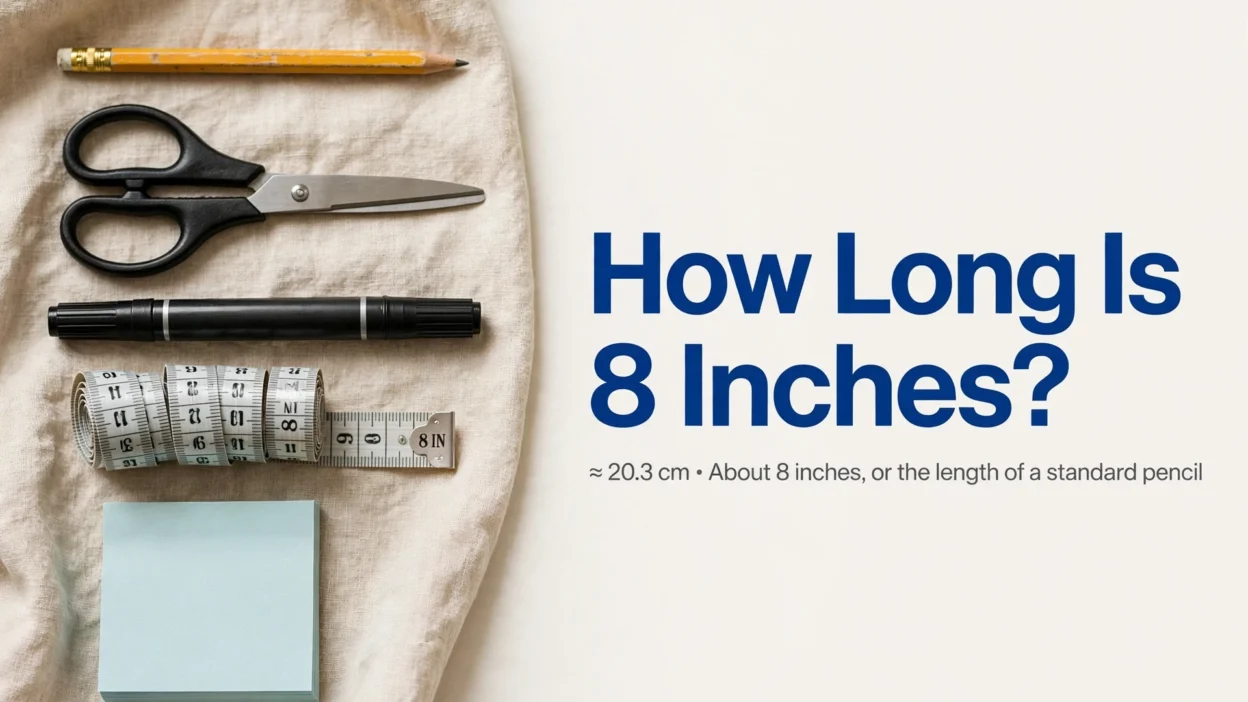
Eight inches is a length you can picture in many everyday situations, from the size of a small tablet to the length of a dinner plate or a standard sheet of paper’s shorter side. Although it may seem like a simple measurement, understanding it becomes easier when you compare it with familiar objects and common units.
Exactly 8 inches equals 20.32 cm, 203.2 mm, 0.6667 ft, and 0.2032 m. These conversions are useful when measuring household items, following craft instructions, checking product dimensions, or working with measurements listed in different units.
Whether you have a ruler nearby or need to estimate the length by sight, this guide explains how long 8 inches is, provides a detailed conversion chart, and introduces 10 everyday objects that can help you visualize the measurement.
How Long Is 8 Inches?
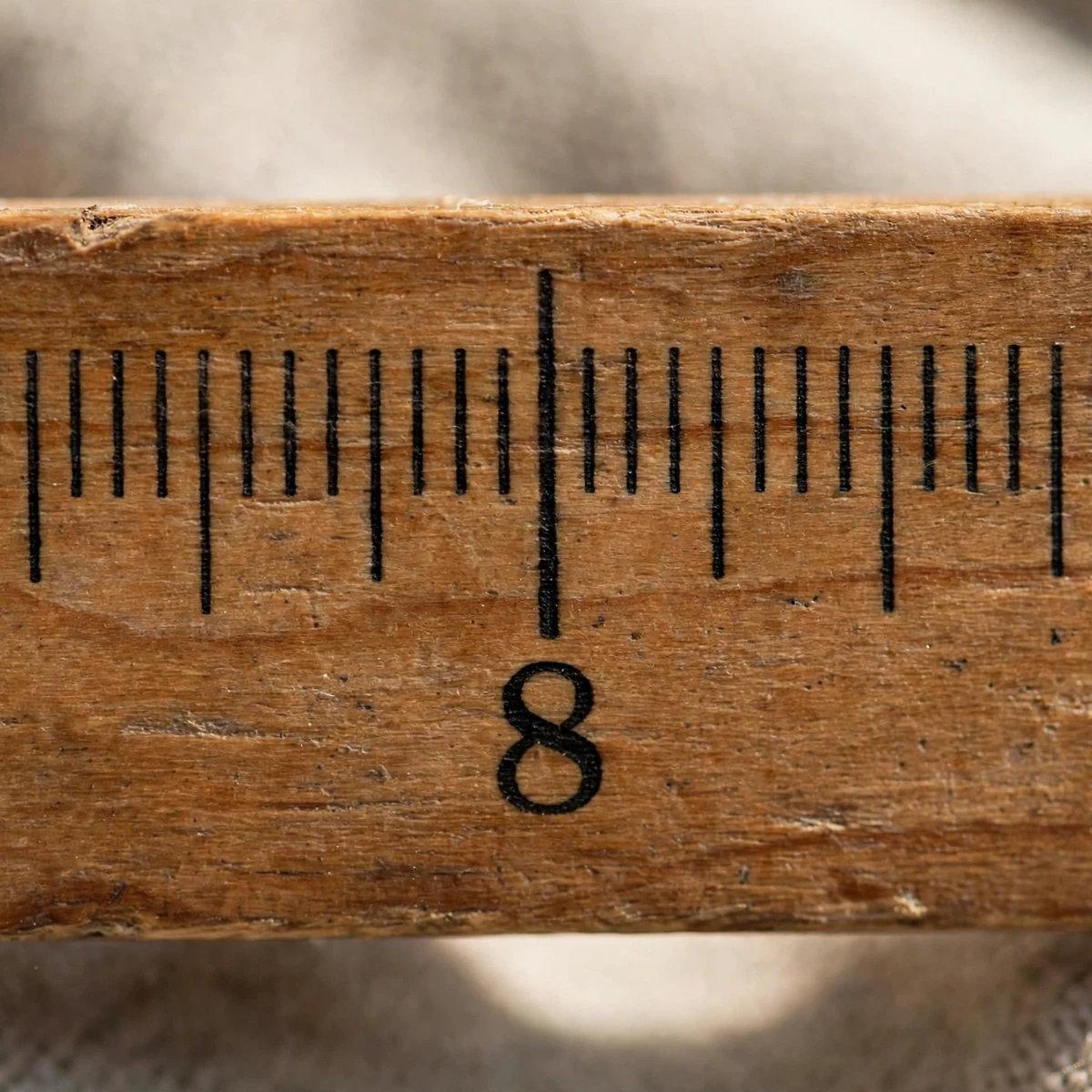
Eight inches is a length of 20.32 centimeters. To picture it, imagine a line extending from the beginning of a standard 12-inch ruler to the 8-inch mark. The distance covers two-thirds of the ruler, making it shorter than a foot but long enough to span many common household objects.
In the United States, inches are widely used for measuring furniture, electronics, clothing accessories, tools, and other everyday products. You might see an 8-inch measurement when shopping for a tablet, choosing a kitchen utensil, cutting material for a craft project, or checking the dimensions of a storage container.
Here are the most useful equivalent measurements for 8 inches: Centimeters: 20.32 cm; Millimeters: 203.2 mm; Feet: Approximately 0.6667 ft; Meters: 0.2032 m; Yards: Approximately 0.2222 yd.
An 8-inch length is also two-thirds of a foot because one foot contains 12 inches. This makes it relatively easy to locate on a standard ruler or measuring tape.
It is important to distinguish between length and other dimensions. For example, a tablet described as 8 inches may have an 8-inch diagonal screen rather than an 8-inch width. Similarly, an 8-inch plate usually refers to its diameter, measured straight across the circular surface.
Understanding what a measurement describes helps you make accurate comparisons. If you need an object that is exactly 8 inches long, check its listed length rather than assuming its largest dimension matches that measurement.
8 Inches Conversion Chart
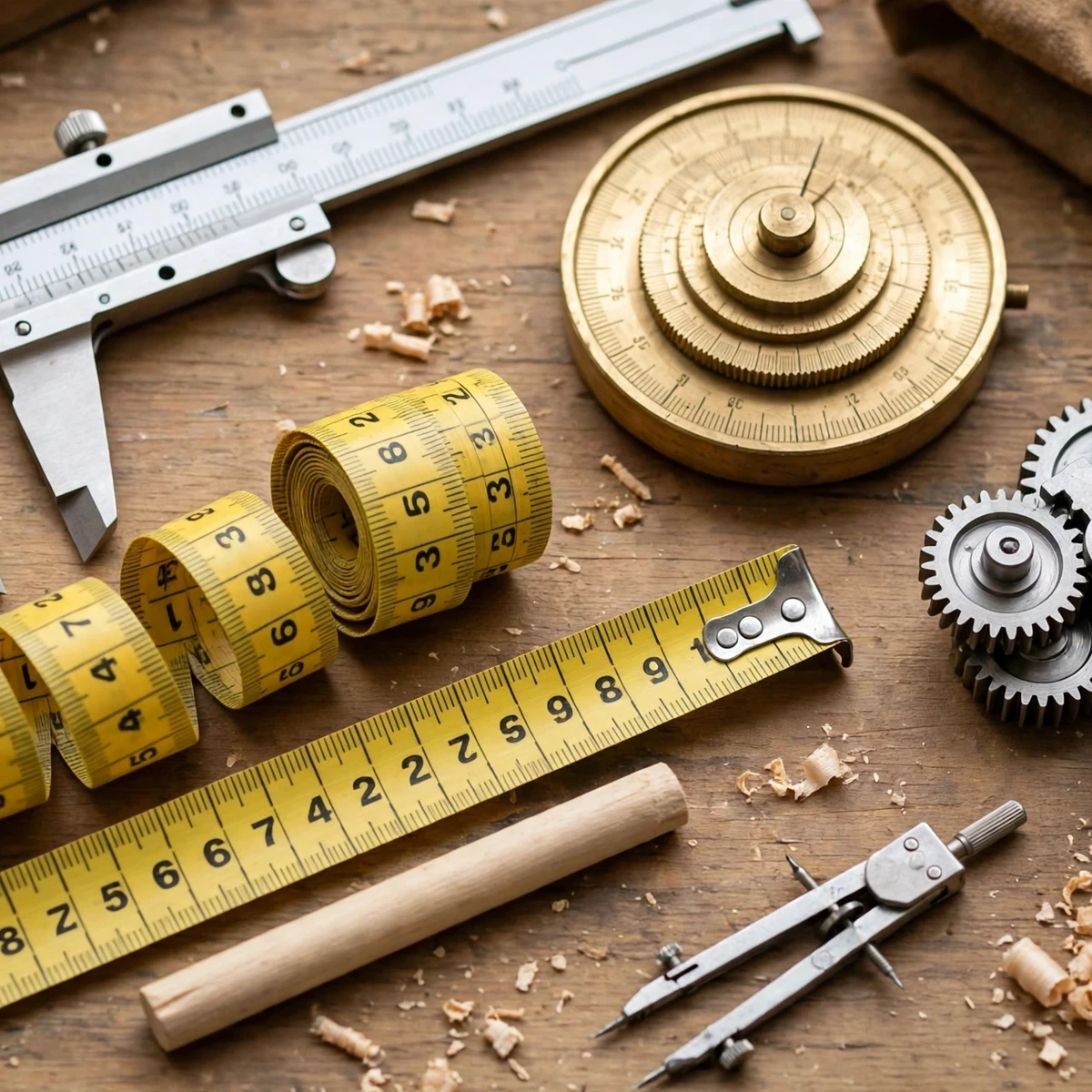
The following chart shows common inch measurements converted into feet, centimeters, millimeters, meters, and yards. It includes values from half an inch through 12 inches, making it useful for comparing 8 inches with shorter and longer lengths.
| Inches | Feet | Cm | Mm | Metres | Yards |
|---|---|---|---|---|---|
| 0.5 | 0.0417 | 1.27 | 12.7 | 0.0127 | 0.0139 |
| 1 | 0.0833 | 2.54 | 25.4 | 0.0254 | 0.0278 |
| 2 | 0.1667 | 5.08 | 50.8 | 0.0508 | 0.0556 |
| 3 | 0.2500 | 7.62 | 76.2 | 0.0762 | 0.0833 |
| 4 | 0.3333 | 10.16 | 101.6 | 0.1016 | 0.1111 |
| 5 | 0.4167 | 12.70 | 127.0 | 0.1270 | 0.1389 |
| 6 | 0.5000 | 15.24 | 152.4 | 0.1524 | 0.1667 |
| 7 | 0.5833 | 17.78 | 177.8 | 0.1778 | 0.1944 |
| 8 | 0.6667 | 20.32 | 203.2 | 0.2032 | 0.2222 |
| 9 | 0.7500 | 22.86 | 228.6 | 0.2286 | 0.2500 |
| 10 | 0.8333 | 25.40 | 254.0 | 0.2540 | 0.2778 |
| 11 | 0.9167 | 27.94 | 279.4 | 0.2794 | 0.3056 |
| 12 | 1.0000 | 30.48 | 304.8 | 0.3048 | 0.3333 |
Note: Decimal values for feet and yards are rounded to four decimal places. Metric conversions are exact for the inch values shown.
The chart makes it easy to see how 8 inches compares with familiar measurements. It is 2 inches longer than a 6-inch measurement and 4 inches shorter than a foot. In metric units, it is slightly more than 20 centimeters.
Simple Conversion Formulas
You do not need to memorize every conversion in the chart. A few simple formulas allow you to convert inches into other units whenever you need to.
- Inches to centimeters – Multiply by 2.54. Formula: Inches x 2.54 = Centimeters. For example: 8 x 2.54 = 20.32 cm
- Inches to millimeters – Multiply by 25.4. Formula: Inches x 25.4 = Millimeters. For example: 8 x 25.4 = 203.2 mm
- Inches to feet – Divide by 12. Formula: Inches / 12 = Feet. For example: 8 / 12 = 0.6667 ft, approximately.
- Inches to meters – Multiply by 0.0254. Formula: Inches x 0.0254 = Meters. For example: 8 x 0.0254 = 0.2032 m
- Inches to yards – Divide by 36. Formula: Inches / 36 = Yards. For example: 8 / 36 = 0.2222 yd, approximately.
These formulas are especially useful when product descriptions use different units. If a craft pattern lists an 8-inch piece but your measuring tape uses centimeters, you can immediately determine that the required length is 20.32 centimeters.
Everyday Objects That Are Around 8 Inches
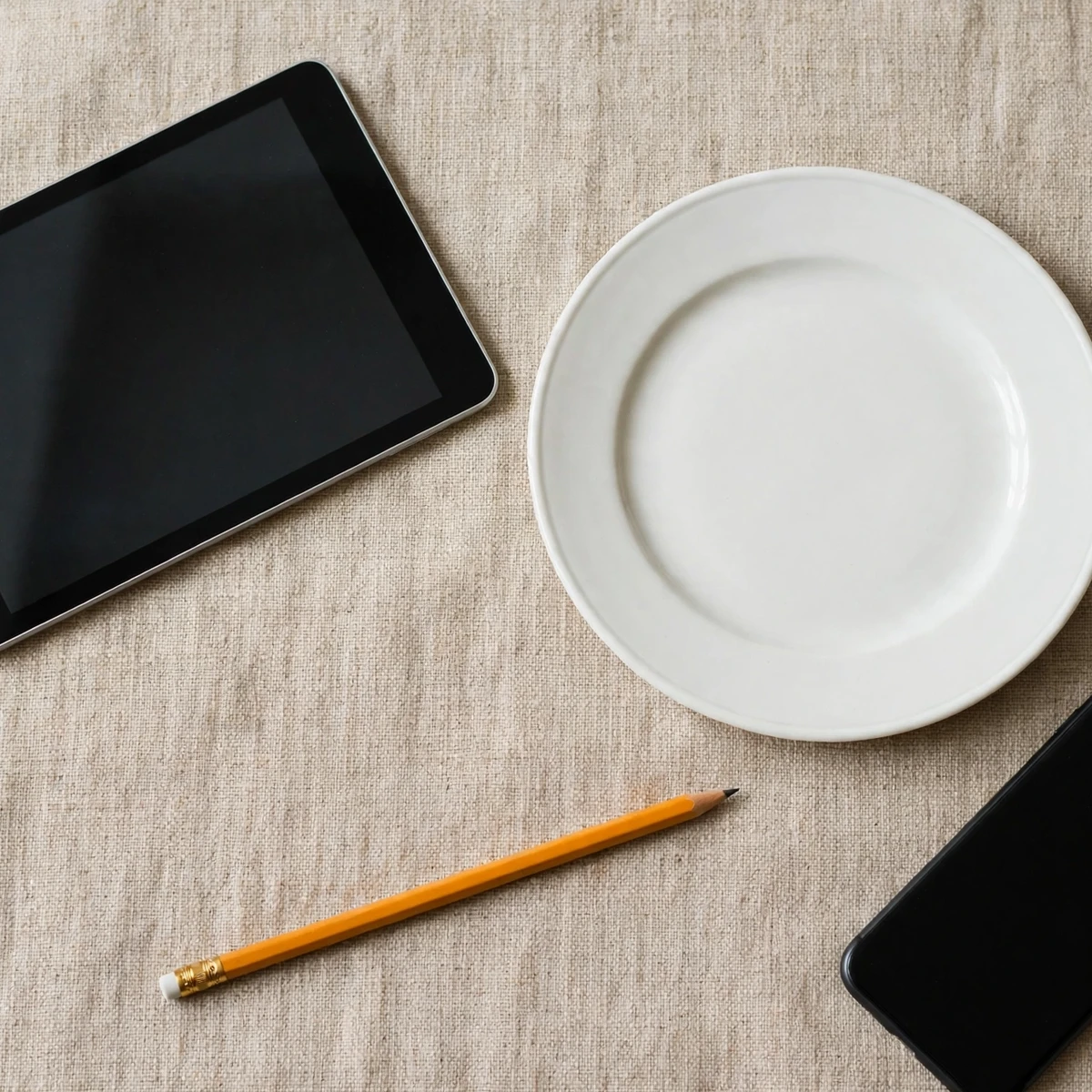
One of the easiest ways to understand a measurement is to compare it with things you already know. You may not carry a ruler everywhere, but you probably encounter objects with dimensions close to 8 inches throughout the day.
Common examples include kitchen utensils, small electronic devices, books, plates, and certain personal accessories. These objects provide practical reference points because you can observe their lengths, widths, or diameters without needing specialized measuring equipment.
However, it is important to remember that an object described as approximately 8 inches long is not necessarily exactly 8 inches. Manufacturers produce different sizes, and the dimensions of similar items can vary considerably.
The measurement also depends on which part of an object you are examining. A circular plate is generally measured by its diameter, while a spoon is measured from the tip of its handle to the end of its bowl. An electronic screen may be measured diagonally instead of horizontally.
For the most reliable comparison, identify the dimension you want to estimate and compare it with the corresponding dimension of the reference object.
10 Everyday Objects That Measure Around 8 Inches

The following 10 everyday objects can help you picture a length of approximately 8 inches. Each is a useful visual reference, although actual measurements depend on the particular product or design.
1. A Small Tablet
A small tablet can be an excellent reference for understanding an 8-inch measurement. Some compact tablets have screens advertised as approximately 8 inches, giving you a familiar electronic device to picture when estimating this length.
However, screen size is measured diagonally from one corner of the display to the opposite corner. It does not mean that the tablet is 8 inches wide or 8 inches tall. The overall device dimensions also include the bezels and frame.
If you have a small tablet, examine its screen and outer body to see how the measurement relates to its size. This can be particularly helpful when comparing compact electronics or deciding whether a device will fit in a bag.
Variation caveat: Tablet screen sizes, body dimensions, aspect ratios, and frame designs vary by brand and model, so an 8-inch screen does not guarantee an 8-inch physical side.
2. A Dinner Plate
A dinner plate or small serving plate can provide another useful comparison. Some plates measure approximately 8 inches across, making their diameter close to the length you want to visualize.
To understand the measurement, imagine drawing a straight line from one edge of the plate to the opposite edge through its center. If the plate has an 8-inch diameter, that line measures 20.32 centimeters.
A circular plate can be easier to use as a visual reference than an irregularly shaped object because its diameter is a clearly defined dimension. Place the plate on a table and picture a straight line spanning its entire width.
Remember that the rim may be wider than the central eating surface, so the outside diameter is usually the relevant dimension when comparing plate sizes.
Variation caveat: Plate diameters vary by brand, model, and design, with some products intended for desserts, side dishes, or full meals.
3. A Standard Pencil
A wooden pencil is a familiar object that can help you estimate lengths. Many traditional full-size pencils are around 7 to 8 inches long before sharpening, depending on the product and its condition.
Imagine placing a pencil horizontally on a desk. Its total length can provide a reasonable approximation of 8 inches, especially if you are using a typical full-size pencil rather than a short golf pencil.
Pencils are useful because they are easy to find in homes, classrooms, and offices. You can also compare the length of a pencil with the width of a notebook or the height of a small container.
If you need a more accurate estimate, remember that a pencil becomes shorter as it is repeatedly sharpened. A new pencil and a well-used pencil may differ noticeably in length.
Variation caveat: Pencil lengths vary by brand, model, and design, and sharpening or trimming changes the usable length.
4. A Large Smartphone
Some large smartphones approach 8 inches in one dimension only when considering certain foldable designs or when measuring diagonally across the screen. Conventional smartphones are usually shorter than 8 inches in their physical height.
A large phone can nevertheless help you develop a sense of scale. Hold it in your hand and compare its height with an imagined 8-inch line. You may find that the target length extends somewhat beyond the device’s top or bottom.
Foldable smartphones require particular care because their screen measurements can be much larger when the device is opened. As with tablets, advertised screen size usually refers to the diagonal rather than the width or height.
This makes a smartphone a helpful comparison, but it is less dependable than a ruler or an object with a known physical length.
Variation caveat: Smartphone dimensions vary by brand, model, and design, and advertised screen diagonals do not directly represent the device’s height or width.
5. A Wooden Cooking Spoon
A wooden cooking spoon can offer a useful kitchen reference because its handle creates a long, easy-to-follow shape. Some compact cooking spoons measure around 8 inches from the end of the handle to the tip of the bowl.
Place the spoon on a countertop and observe its overall length. You can use it to visualize the distance from one end of an 8-inch line to the other, particularly if you have a compact utensil.
Cooking spoons are also convenient for comparing lengths in everyday tasks. For example, you might use one as a rough reference when deciding whether a small kitchen drawer can accommodate a utensil.
Still, do not assume that every wooden spoon is close to 8 inches. Many cooking spoons are considerably longer, especially those designed for deep pots or large cookware.
Variation caveat: Wooden spoon lengths vary by brand, model, and design, including the shape of the handle and the size of the spoon bowl.
6. A Small Paperback Book
A small paperback book may measure around 8 inches along its height or width, depending on its format. Certain compact books have one dimension close to this length, making them convenient household references.
To use a book as a comparison, identify its vertical height or horizontal width and picture that dimension as a straight line. The book’s height may be more relevant when comparing it with a standing object, while its width can help you estimate the span of a surface.
Books are useful because their rectangular shapes make dimensions easy to imagine. You can also place one beside another object to judge which is longer without measuring every item separately.
However, book formats differ substantially. A pocket-sized paperback may be much smaller, while a large trade paperback or illustrated book may exceed 8 inches in one or both dimensions.
Variation caveat: Paperback dimensions vary by publisher, model, and design, including the book’s format, page layout, and intended use.
7. A Compact Hairbrush
A compact hairbrush may be close to 8 inches long from the end of its handle to the far edge of its bristles. This makes it a potentially useful reference when getting ready in the morning or organizing bathroom accessories.
Look at the entire brush rather than just the bristle-covered section. The handle contributes to the total length, and the brush head may account for a substantial part of the measurement.
If you keep a hairbrush on a dressing table, you can use its overall length to picture an 8-inch line. It may also help when estimating the dimensions of a small storage compartment or travel toiletry bag.
A compact brush is not a universal standard, however. Some brushes are deliberately short for travel, while others have long handles designed for styling or reaching through thick hair.
Variation caveat: Hairbrush dimensions vary by brand, model, and design, including the handle length, head shape, and bristle arrangement.
8. A Dinner Fork
A dinner fork is another everyday item that can help you visualize a length close to 8 inches. Some full-size forks approach this measurement from the tips of the tines to the end of the handle.
Place the fork on a flat surface and examine its full length. Its relatively straight shape makes it easy to compare with an imaginary line, although the curved handle and pointed tines mean that it should be treated as an approximate reference.
A fork can be especially convenient when estimating measurements in a dining area or kitchen. You might use it to picture the length of a small object or judge whether something is noticeably shorter than 8 inches.
Keep in mind that forks are produced in different sizes. Salad forks and dessert forks are often shorter than full-size dinner forks, and some oversized serving forks are considerably longer.
Variation caveat: Fork lengths vary by brand, model, and design, including whether the utensil is intended for dinner, dessert, or serving.
9. A Compact Computer Keyboard
A compact computer keyboard can help illustrate an 8-inch measurement when you examine its depth rather than its width. Some small keyboards have front-to-back dimensions near this length, although many are shallower or deeper.
Place the keyboard on a desk and identify the distance from its front edge to its back edge. That measurement may be a useful reference for 8 inches, particularly when considering desk space or the placement of accessories.
It is important not to confuse keyboard depth with keyboard width. Even compact keyboards are generally wider than 8 inches, and full-size models can be substantially wider because they include additional keys and number pads.
If you are arranging a workspace, comparing the depth of a keyboard with other desk items can help you visualize the available space before measuring it precisely.
Variation caveat: Keyboard dimensions vary by brand, model, and design, particularly according to the key layout, number pad, and overall casing.
10. A Small Cutting Board
A small cutting board may measure approximately 8 inches across its shorter side or along its length. Compact boards are commonly used for preparing fruit, slicing small ingredients, or handling simple kitchen tasks.
The board’s flat surface makes it easy to visualize a straight measurement. If one side measures around 8 inches, you can imagine that distance running between its opposite edges.
A cutting board is also a practical reference when thinking about counter space. For example, an 8-inch board gives you a sense of how much room a small food-preparation surface occupies.
However, cutting boards come in many shapes and sizes. Some are designed for occasional food preparation and are quite small, while others are intended for chopping large vegetables, carving meat, or preparing several ingredients at once.
Variation caveat: Cutting-board dimensions vary by brand, model, and design, including the board’s shape, thickness, and intended kitchen use.
How to Estimate 8 Inches Without a Ruler
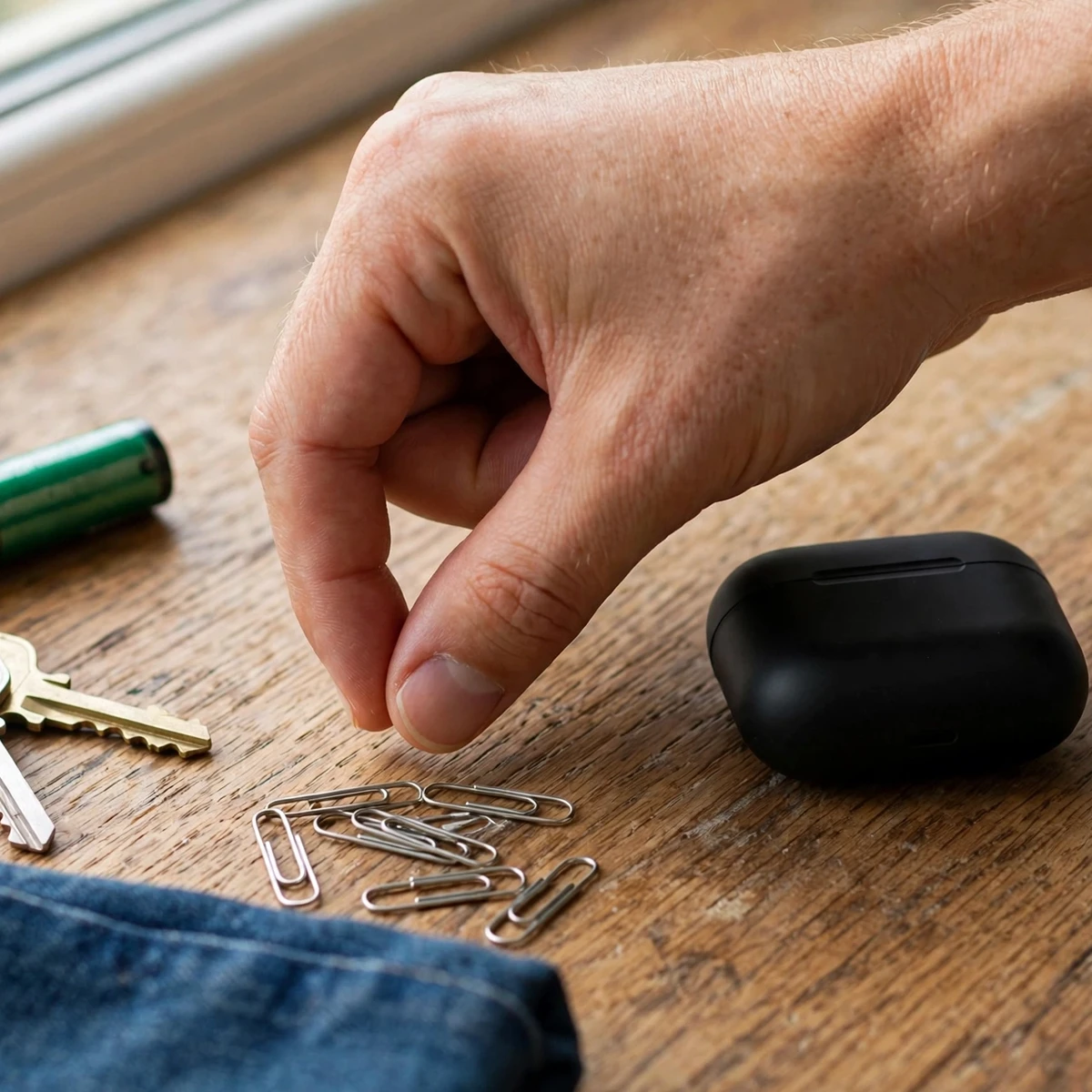
You can estimate 8 inches without a ruler by using familiar objects, simple body-based references, or visual comparisons. These methods are useful for everyday situations when precision is not critical.
The main goal is to establish a reference that is reasonably close to the desired measurement. If the measurement affects construction, fitting, safety, or a precise craft project, confirm it with an actual measuring tool whenever possible.
Use the Length of a Familiar Object
Choose an object whose length you know or can estimate confidently. A full-size pencil, compact kitchen utensil, or small tablet may help you picture a distance near 8 inches.
Imagine placing the object along the line you want to measure. If the object is approximately the right length, it gives you a starting point for estimating the distance.
This approach works best when you use the same reference object repeatedly. Over time, you can become more comfortable recognizing what an 8-inch distance looks like.
However, the comparison is only as reliable as your reference. An unfamiliar object with an assumed length can introduce a significant error.
Compare the Measurement With a Standard Foot
A standard foot contains 12 inches, so 8 inches is exactly two-thirds of a foot.
If you have a 12-inch ruler, imagine dividing its length into three equal sections. Each section would be 4 inches long, and two sections together would equal 8 inches.
You can apply the same principle when estimating a foot-long object. Visualize dividing its length into three equal portions and use two of those portions as your target.
This method is especially useful because it relies on a simple mathematical relationship rather than a particular household object.
Use Your Hand as a Rough Reference
Your hand can provide a convenient personal reference once you know its approximate dimensions. For example, you might compare the distance across your palm or the length of your hand with a measurement you have previously checked.
The important step is to avoid assuming that every person’s hand has the same dimensions. Hand sizes vary, and the width of your palm is different from the length of your hand or fingers.
If you want to use your hand consistently, measure it once with a ruler and remember the result. You can then use that known dimension to estimate longer distances.
For instance, if a particular hand measurement is about 4 inches, placing that span twice in a straight line would give an approximate 8-inch distance.
Count Equal Sections on a Known Length
Another useful method is to divide a familiar length into equal sections mentally. If you can picture a 12-inch ruler, you know that each quarter of its length represents 3 inches.
Three quarters of that ruler would measure 9 inches, which is 1 inch longer than your target. This provides a rough comparison when you cannot remember the exact two-thirds relationship.
Alternatively, if you know a 16-inch span, half of it is 8 inches. This makes any familiar object or distance that is close to 16 inches a useful reference when estimating half its length.
The method is most effective when the starting measurement is known. Guessing the length of the original object and then dividing it can compound the error.
Use a Printable or Digital Reference Carefully
A printed measurement guide can help when a ruler is unavailable, but the print settings must be correct. If a document is scaled to fit the page, the printed measurements may no longer match their intended dimensions.
For a digital reference, the displayed size on a screen is not automatically a reliable physical measurement. Screens have different pixel densities, scaling settings, and display sizes.
If you use a printable ruler, select the appropriate actual-size or 100% printing option and check a known reference mark before relying on it.
For any task where a small error could cause a problem, a physical ruler or tape measure remains the better choice.
Frequently Asked Questions About 8 Inches
How Many Centimeters Are in 8 Inches?
Eight inches equals exactly 20.32 centimeters. To convert inches to centimeters, multiply the inch measurement by 2.54. Therefore, 8 x 2.54 = 20.32 cm.
How Many Millimeters Are in 8 Inches?
Eight inches equals 203.2 millimeters. Since one inch contains 25.4 millimeters, multiplying 8 by 25.4 gives 203.2 mm.
Is 8 Inches More Than Half a Foot?
Yes. Half a foot equals 6 inches, while 8 inches is 2 inches longer. Because a full foot contains 12 inches, 8 inches represents two-thirds of a foot.
Is 8 Inches the Same as 20 Centimeters?
Not exactly. Eight inches equals 20.32 centimeters, which is 0.32 centimeters longer than 20 centimeters. The difference is small, but it can matter when precise measurements are required.
How Can I Measure 8 Inches Without a Ruler?
You can estimate 8 inches by comparing the distance with a familiar object, using a known hand measurement, or imagining two-thirds of a 12-inch ruler. These methods provide approximations rather than guaranteed exact measurements.
What Household Objects Are About 8 Inches Long?
Depending on their dimensions, examples may include compact tablets, wooden cooking spoons, small cutting boards, paperback books, hairbrushes, and some dinner forks. Their actual measurements vary, so check the specific object if accuracy matters.
Is an 8-Inch Tablet Actually 8 Inches Long?
Not necessarily. Tablet screen sizes are generally measured diagonally across the display. An 8-inch screen therefore does not mean the device’s height or width is 8 inches.
How Many Feet Is 8 Inches?
Eight inches equals two-thirds of a foot, or approximately 0.6667 feet. To convert inches into feet, divide the number of inches by 12.
How Many Meters Is 8 Inches?
Eight inches equals exactly 0.2032 meters. You can calculate this by multiplying 8 by 0.0254, the number of meters in one inch.
Why Is It Useful to Know What 8 Inches Looks Like?
Knowing what 8 inches looks like helps you estimate the size of everyday objects, plan small projects, compare product dimensions, and understand instructions that use inches. It is also useful when switching between customary and metric measurements.
Final Thoughts
Eight inches is a practical measurement that appears in many everyday situations. Equal to 20.32 centimeters, 203.2 millimeters, and approximately two-thirds of a foot, it is easy to convert once you know a few basic formulas.
Comparing this length with familiar items such as compact tablets, cooking utensils, books, plates, and cutting boards can help you visualize it without reaching for a ruler. However, these objects should be treated as reference points rather than exact standards because their dimensions vary by brand, model, and design.
When precision matters, use a ruler or tape measure and identify the specific dimension you need. For quick estimates, a familiar object or a known fraction of a foot may be sufficient.
Understanding common measurement units makes it easier to interpret product specifications, complete household tasks, and communicate measurements accurately. With a little practice, recognizing a length of 8 inches becomes a straightforward part of everyday measuring.

Grace is a lifestyle writer from California who loves starting mornings with positivity. At Mornetic, she shares uplifting quotes and cheerful messages to brighten your day.