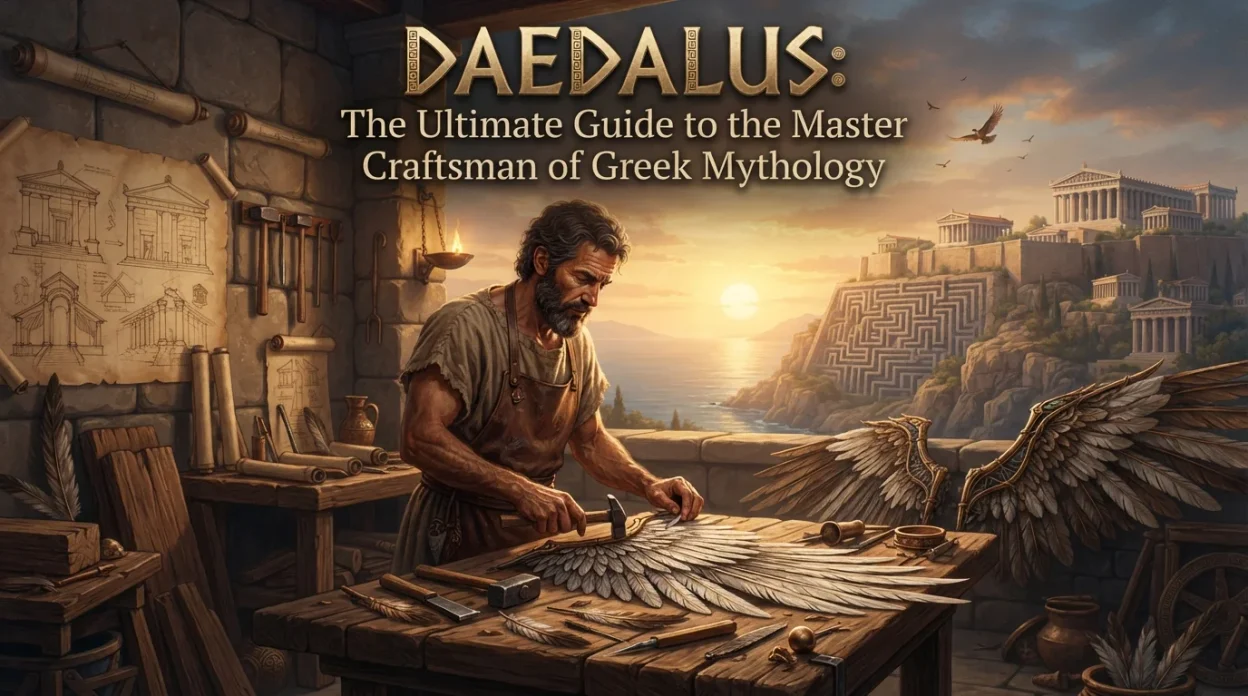
Daedalus was a legendary Greek craftsman and inventor, famous for building the Labyrinth for King Minos of Crete and for creating the wax wings that led to his son Icarus’s tragic death. He is seen as a symbol of wisdom, knowledge, and the dangers of unchecked ambition.
If you have ever heard the phrase “flying too close to the sun,” you have encountered the legacy of Daedalus. He was the ultimate inventor of Greek mythology, a genius whose creations were as brilliant as they were dangerous. Moreover, his story raises timeless questions about pride, responsibility, and the limits of human ingenuity. Let’s explore everything you need to know about this fascinating figure.
H2: Who Was Daedalus?
Daedalus was a skillful architect, craftsman, and inventor from Greek mythology. He is best known as the father of Icarus and the architect of the Labyrinth on Crete . The ancient Greeks closely associated him with Hephaistos, the god of craftsmen, and he came to represent the ideal of the supreme master craftsman .
His name itself became a byword for cleverness. The word daidalos in ancient Greek meant “finely-worked” or “elaborate” . Over time, many Greek craftsmen and inventions were attributed to him, often just to honor his legendary skill.
H3: Family and Origins
Daedalus’s parentage varies across different sources. His father is claimed to be either Eupalamus, Metion, or Palamaon. His mother was either Alcippe, Iphinoe, Phrasmede, or Merope . He had two sons: Icarus and Iapyx, along with a nephew named Talos (or Perdix) .
The Athenians later rewrote his story to claim him as one of their own. They made him a descendant of King Erechtheus and said he fled to Crete after a terrible crime .
H2: The Genius of Daedalus: His Famous Inventions
Daedalus was credited with an astonishing range of inventions. Some were practical, some were magical, and some were deeply disturbing.
H3: The Wooden Cow for Pasiphae
The story begins with a curse. Poseidon, god of the sea, gave King Minos a beautiful white bull to sacrifice. However, Minos kept the bull for himself and sacrificed another animal instead .
As revenge, Poseidon made Minos’s wife, Pasiphae, fall in love with the bull. She begged Daedalus for help. He built her a hollow wooden cow covered in real cowhide so she could hide inside and mate with the bull .
The result of this unnatural union was the Minotaur, a creature with the body of a man and the head of a bull .
H3: The Labyrinth
King Minos needed a prison for the Minotaur. He turned to Daedalus, who designed the Labyrinth, a maze so cunning that no one who entered could find their way out .
The Labyrinth had countless winding passages and turns that opened into one another. It seemed to have neither beginning nor end. According to Ovid, Daedalus built it so skillfully that he himself could barely escape after constructing it .
The Labyrinth was so iconic that it appeared on ancient Cretan coins as a symbol .
H3: The Wings of Wax and Feathers
Daedalus’s most famous invention was also his most tragic. After he fell out of favor with King Minos, he and his son Icarus were imprisoned. To escape, Daedalus fashioned wings from bird feathers, thread, and beeswax .
He warned Icarus not to fly too high, because the sun would melt the wax, nor too low, because the sea foam would soak the feathers . But Icarus, overcome with the joy of flight, ignored his father’s warning.
H3: Other Inventions
Daedalus was credited with many other creations. These include:
- The saw: His nephew Talos invented it by notching a fish spine, which made Daedalus jealous .
- The compass: Also attributed to his nephew .
- Masts and sails: For King Minos’s navy .
- Living statues: He supposedly carved statues so lifelike they appeared to move .
- The dancing floor for Ariadne: Mentioned by Homer in the Iliad .
H2: The Story of Daedalus and Icarus
The most famous story involving Daedalus is the tragic tale of his son, Icarus. It is a story about freedom, disobedience, and the devastating consequences of hubris .
H3: The Imprisonment
After Theseus, the Athenian hero, came to Crete to kill the Minotaur, Ariadne (Minos’s daughter) fell in love with him. She asked Daedalus for help, and he gave her the secret of the Labyrinth: a ball of thread. Theseus tied the thread to the entrance, killed the Minotaur, and followed the thread back out .
Minos was furious. He imprisoned Daedalus and Icarus in the Labyrinth (or in a tower, depending on the version) . Some versions say Pasiphae released them, but they still could not leave Crete because Minos controlled all the ships .
H3: The Escape
Daedalus refused to be trapped. Since he could not escape by land or sea, he decided to escape by air . He gathered feathers of different sizes and fastened them together with thread and beeswax, shaping them into wings .
He warned Icarus: “Fly a middle course. If you go too low, the water may weigh down your wings. If you go too high, the heat may burn them.”
H3: The Fall of Icarus
At first, everything went well. They flew past Samos, Delos, and Lebynthos . But Icarus, thrilled by the sensation of flight, forgot his father’s warnings. He soared higher and higher, toward the sun.
The heat melted the beeswax. The feathers fell away. Icarus plunged into the sea and drowned .
Daedalus, seeing the feathers floating on the water, wept and cursed his own art. He buried his son’s body on an island and named it Icaria in his memory. The sea where Icarus fell became known as the Icarian Sea .
H2: Daedalus in Sicily and the Death of Minos
After burying Icarus, Daedalus flew to Sicily. He found refuge with King Cocalus .
H3: The Shell Riddle
Minos, still furious, searched for Daedalus across the Mediterranean. He devised a clever test: he carried a spiral seashell and asked anyone he met to thread a string through it. He knew only Daedalus could solve such a puzzle .
When Minos reached Sicily, King Cocalus accepted the challenge and gave the shell to Daedalus. Daedalus tied a string to an ant and lured it through the shell with a drop of honey. The ant walked through the spiral, pulling the string behind it .
Minos realized Daedalus was there and demanded his surrender. Cocalus agreed—but asked Minos to take a bath first. In the bath, Cocalus’s daughters killed Minos, possibly by pouring boiling water over him .
H2: Daedalus as a Symbol
Daedalus represents several powerful ideas in Greek mythology and Western culture.
H3: The Genius Craftsman
Daedalus is the archetype of the brilliant inventor. He could solve any problem, build any device, and escape any trap. Moreover, he represents the heights of human ingenuity and the power of knowledge .
H3: The Warning Against Hubris
The story of Icarus is a classic warning against over-ambition and pride. Icarus flew too close to the sun, ignoring his father’s wisdom. Consequently, he paid with his life. The phrase “flying too close to the sun” remains part of everyday speech, a warning against bravado and recklessness .
H3: The Complexity of Morality
Daedalus is not a simple hero.His story raises difficult questions about the ethics of invention and the responsibility of creators.
H2: Daedalus in Art and Literature
The myth of Daedalus and Icarus has inspired artists and writers for thousands of years.
H3: Ancient Art
Daedalus and Icarus appear in Greek art as early as circa 560 BCE. They also appear on an Etruscan gold amulet from circa 470 BCE. The Labyrinth was a popular motif in Roman mosaics .
H3: Ovid’s Metamorphoses
The Roman poet Ovid gave the myth its most famous literary treatment in his Metamorphoses. Ovid’s version emphasizes the tragic intimacy between father and son, with Daedalus weeping as he buries Icarus .
H3: Later Interpretations
The myth has inspired countless works, including:
- Shakespeare referenced it in several plays.
- John Milton alluded to it in Paradise Lost.
- James Joyce used the name Stephen Dedalus in A Portrait of the Artist as a Young Man and Ulysses .
- W.H. Auden wrote the poem Musée des Beaux Arts about Bruegel’s painting of the fall of Icarus .
The painting Auden wrote about shows Icarus’s legs disappearing into the sea while a ship sails calmly on. Auden’s poem is a meditation on how life continues even in the face of tragedy .
H2: FAQ
Who was Daedalus?
Daedalus was a legendary Greek craftsman, architect, and inventor. He built the Labyrinth for King Minos and created the wings that led to his son Icarus’s death .
What was Daedalus famous for?
He was famous for designing the Labyrinth, building the wooden cow for Pasiphae, and inventing the wings of wax and feathers. He was also credited with inventing the saw, the compass, and masts for ships .
Why did Daedalus build the Labyrinth?
King Minos asked him to build a prison for the Minotaur, the half-man, half-bull creature born from Pasiphae’s union with a sacred bull .
What happened to Icarus?
Icarus flew too close to the sun despite his father’s warnings. The wax on his wings melted, and he fell into the sea and drowned .
Why was Daedalus imprisoned?
Minos blamed Daedalus for helping Theseus escape the Labyrinth after killing the Minotaur. He imprisoned Daedalus and Icarus in the Labyrinth or a tower .
What is the moral of the Icarus story?
The story warns against hubris, or excessive pride and ambition. It teaches that ignoring wise advice and overreaching can lead to disaster .
Did Daedalus die?
The myths do not describe Daedalus’s death. After escaping to Sicily, he lived under King Cocalus’s protection and continued to create masterworks .
H2: Conclusion
Daedalus is one of the most complex and enduring figures in Greek mythology. He was a genius, a murderer, a father, and a symbol of both human potential and human folly. His story reminds us that great gifts can be used for good or for harm. Moreover, it warns that even the wisest among us can make tragic mistakes.
The myth of Daedalus and Icarus continues to resonate today. It speaks to anyone who has ever reached too high, ignored advice, or paid the price for ambition. Whether you see Daedalus as a hero, a villain, or something in between, his story is unforgettable.

hwuduwgdul