Last Updated: March 15, 2026
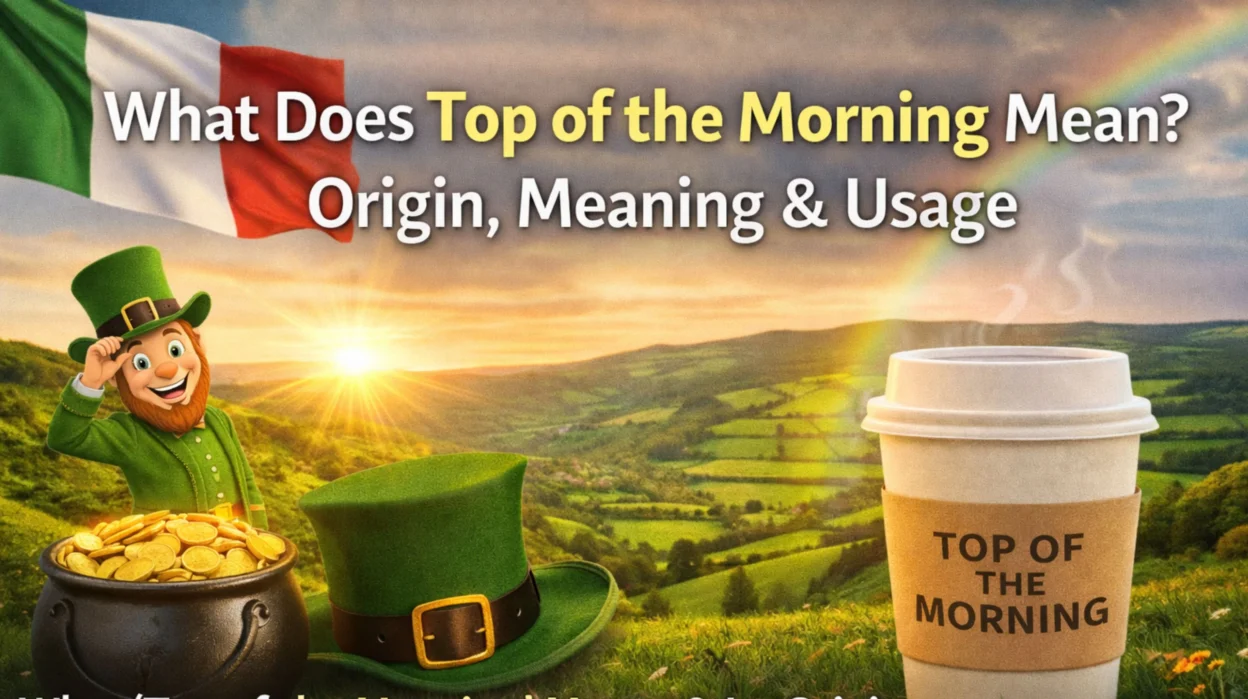
“Top of the morning to you!” is one of the most recognizable — and often misunderstood — greetings in the English language. Many people associate this cheerful phrase with Ireland, but the story behind “top of the morning” is far more complex than most realize. So what does top of the morning mean, and where did this famous expression actually come from?
Originally used as a friendly way to wish someone the best start to their day, the phrase “top of the morning to you” has traveled through centuries of literature, storytelling, and popular culture. Over time, it transformed from a genuine greeting into a widely recognized cultural symbol — sometimes celebrated, sometimes misunderstood.
Whether you’ve heard the phrase in classic films, during St. Patrick’s Day celebrations, or through online creators saying “top of the morning to you laddies,” this guide will explore everything you need to know. We’ll uncover the **origin of “top of the morning,” explain its true meaning, and examine how the phrase is used in modern culture today.
What Does Top of the Morning Meaning?
The phrase “top of the morning” is a traditional greeting that means wishing someone the best part of the morning. When someone says “top of the morning to you,” they are essentially expressing a cheerful wish for you to have the finest or most pleasant start to the day.
The word “top” in this expression refers to the best or choicest part of something. So the phrase “top of the morning meaning” can be understood as wishing someone the very best of the morning hours.
The Literal Meaning and Historical Origins
Top of the Morning Origin
The origin of the phrase “top of the morning” dates back to the late 18th century. One of the earliest recorded uses appeared in the 1796 novel “Theodore Cyphon” by English author George Walker.
Although many people believe the phrase is purely Irish, historical evidence suggests that it was used throughout the British Isles, including England, Scotland, and Ireland. Over time, literature and media strongly connected the expression with Irish characters and culture.
Top of the Morning to You Meaning
The full greeting “top of the morning to you” means “I wish you the best part of the morning.” It was traditionally used as a cheerful way to greet someone early in the day.
A classic response to this greeting was:
“And the rest of the day to you.”
This response extended the goodwill beyond the morning and wished the other person a great day overall.
Breaking Down the Phrase Word by Word
The phrase “top of the morning” operates on both literal and metaphorical levels. The word “top” in this context carries two significant meanings that help explain the phrase’s essence. First, it refers to “the best or choicest part,” similar to expressions like “cream of the crop” or “top shelf.” Second, it denotes “the earliest part of a period,” referring specifically to the beginning of the morning hours. This dual meaning suggests the phrase originally wished someone both the “finest quality” morning and a positive start to their day.
The complete greeting “Top of the morning to you” essentially means: “I wish you the best part of the morning” or “May you have the finest morning possible.” It’s a benevolent expression hoping the recipient experiences the very best that the current morning has to offer. Unlike simple greetings like “hello” or “good morning,” this phrase carries a more specific well-wishing quality, emphasizing the desire for the person to have not just a good morning, but the best possible version of it.
First Recorded Uses and Early History
Contrary to popular belief, “top of the morning” didn’t originate as exclusively Irish. The first recorded use of “top of the morning to you” as a greeting appears in English author George Walker’s 1796 novel “Theodore Cyphon: Or, The Benevolent Jew.” Early uses appeared throughout British literature, including in Sir Walter Scott’s “The Heart of Mid-Lothian” (1818) and works by Robert Louis Stevenson and William Makepeace Thackeray.
Historical evidence suggests the phrase was used more broadly throughout the British Isles during the 18th and 19th centuries, with similar morning greeting patterns appearing in English, Scottish, and Irish contexts. The expression likely evolved from earlier English phrases that used “top” to indicate the best of something, such as “top of the game” or “top of one’s condition,” applying this construction specifically to the morning hours.
The Milk Theory and Agricultural Origins 🥛
One popular folk etymology suggests the phrase may originate from dairy farming practices. In unhomogenized milk, cream naturally rises to the top, representing the richest, most valuable part of the milk. Wishing someone the “top of the morning” thus metaphorically offered them the very best the day had to offer, just as one might offer the prized cream of the milk to an honored guest.
While this theory is difficult to verify historically, it aligns with many agricultural expressions in the English language that draw from rural life. Similar phrases include “cream of the crop” for the best of a group and “prime cut” for the best portion of meat. Whether literally true or not, the milk theory provides a vivid illustration of how the phrase might have developed within communities where dairy farming was a central part of daily life.
The Irish Connection: How a Phrase Became Stereotypically Irish
The Statistical Shift in Association
While “top of the morning” began as a general British Isles expression, it became overwhelmingly associated with Irish culture throughout the 19th and 20th centuries. Research into historical texts shows that from approximately 1829 onward, instances of the phrase appearing in an Irish context dramatically outnumbered all other uses combined. Literary works increasingly placed these words in the mouths of Irish characters, cementing the association in the public imagination.
Several factors contributed to this shift. As Irish immigration increased throughout the English-speaking world, particularly to the United States, elements of Irish culture became both romanticized and stereotyped. The phrase “top of the morning” captured an imagined Irish cheerfulness and linguistic flair that appealed to writers and later filmmakers seeking to quickly establish a character’s Irishness. What began as a genuine regional variation became exaggerated into a defining characteristic.
Hollywood’s Role in Popularizing the Irish Association
The phrase’s popularization as distinctly “Irish” accelerated dramatically in the mid-20th century through what linguists now term “Hollywood Irish”—a set of exaggerated speech patterns and characteristics assigned to Irish characters in American films. Key moments in this transformation include the 1949 musical film “Top o’ the Morning” starring Bing Crosby, which directly incorporated the phrase into its title and featured it prominently throughout the film.
Other significant media appearances that cemented the phrase’s Irish association include:
- 1959: Disney’s “Darby O’Gill and the Little People” prominently featured the phrase
- Advertising: Lucky Charms cereal commercials with a cartoon leprechaun using the greeting
- Television: Various shows featuring Irish or Irish-American characters using the expression
These media portrayals created a feedback loop that solidified the phrase as stereotypically Irish in American and international consciousness, often overshadowing its more complex linguistic history.
Irish Diaspora and Cultural Identity
The embrace and transformation of “top of the morning” within Irish diaspora communities, particularly in the United States, represents a fascinating aspect of cultural adaptation. For generations removed from Ireland, certain exaggerated expressions became markers of cultural identity—ways to perform and celebrate Irish heritage even as more authentic linguistic patterns faded.
This phenomenon isn’t unique to Irish culture; many immigrant communities develop heightened or simplified versions of cultural markers that become meaningful within new contexts. “Top of the morning” served as an easily recognizable signal of Irish identity that could be deployed during cultural celebrations or when connecting with other Irish-Americans, even as the phrase saw limited use in Ireland itself.
Traditional Usage and Response Patterns
The Traditional Response and Its Meaning
When someone wished you “top of the morning,” the proper traditional reply was: “And the rest of the day to yourself.” This elegant reciprocation extended the goodwill beyond the morning hours, essentially saying, “Since you’ve wished me a good morning, I wish you a good entire day.” The exchange created a mutual well-wishing that covered the full day ahead.
This call-and-response pattern mirrors similar traditional greetings found in various cultures, where specific phrases trigger standardized replies. The structure creates a small ritual of mutual respect and goodwill, strengthening social bonds through predictable, culturally shared language patterns. In communities where these exchanges were common, they served as verbal handshakes—recognized patterns that established friendly intentions.
Regional Variations and Adaptations
The phrase spawned several regional variations that added local flavor while maintaining the core meaning:
- “Top o’ the morning to ya” – The most recognized Irish-tinged version, often with dropped consonants
- “Top of the mornin'” – A casual contraction commonly heard in some regions
- “Top of the morning to yourself” – Used in reciprocal greeting in some areas
- “The top of the morning” – A slightly more formal version without the “to you”
These variations demonstrate how a core phrase adapts to different speech patterns, regional accents, and social contexts while retaining its essential meaning. The flexibility of the expression allowed it to fit various conversational styles while remaining recognizable across regions.
Social Contexts and Appropriate Usage
Traditionally, “top of the morning” served specific social functions beyond simple greeting:
- Morning-specific: Used only in the morning hours, typically before noon
- Friendly but not intimate: Appropriate for acquaintances and friendly strangers
- Rural associations: More common in agricultural than urban settings
- Class distinctions: Used across classes but with different frequency and inflection
Understanding these traditional contexts helps explain why the phrase eventually fell out of common use as societies became more urbanized and communication patterns changed. The specific social niches where it thrived gradually diminished, leaving the phrase primarily as a cultural memory rather than living speech.
Modern Usage: Stereotypes, Sensitivity and Cultural Context
Current Status in Ireland Today
Despite its strong association with Irish culture, the phrase is rarely used in everyday conversation in modern Ireland. When employed by non-Irish people toward Irish individuals, it can sometimes feel stereotypical or even patronizing. Contemporary Irish English has evolved significantly, with its own distinctive phrases and speech patterns that rarely include “top of the morning” outside of ironic or self-conscious usage.
One Irish commentator noted: “We’ve never once heard an Irishman say ‘Top of the morning'” in genuine conversation, highlighting the disconnect between the phrase’s perception and reality. Modern Ireland has a vibrant, evolving linguistic culture that includes both traditional Irish language influences and contemporary global English, making the continued association with this particular phrase feel increasingly anachronistic to many Irish people.
Potential for Offense and Cultural Sensitivity
While not inherently offensive, the phrase can be problematic in certain contexts:
- When used with an exaggerated Irish accent – This can feel like mockery rather than genuine greeting
- When reinforcing reductive stereotypes – Reducing Irish culture to a few stock phrases oversimplifies a rich cultural tradition
- In professional contexts – May seem unserious or culturally insensitive
- In Northern Ireland – Where it may oversimplify complex cultural and political identities
Many Irish and Irish-American people view the phrase as part of an artificial, Hollywood-created identity that doesn’t reflect their actual speech patterns or cultural expressions. The appropriateness often depends on context, relationship between speakers, and awareness of the phrase’s complicated history.
Generational Differences in Perception
Attitudes toward “top of the morning” vary significantly by generation, both within Ireland and among the Irish diaspora:
- Older generations – May view it with amusement or mild irritation
- Middle generations – Often see it as a harmless stereotype, if occasionally tiresome
- Younger generations – Frequently use it ironically or reclaim it as humorous cultural reference
These generational differences reflect broader patterns in how cultural stereotypes are processed and responded to across age groups, with younger people often developing more complex relationships to stereotypical representations of their heritage.
The Phrase in Global Popular Culture
Film and Television Appearances
Beyond its mid-20th century Hollywood origins, “top of the morning” continues to appear in entertainment media, though often with different connotations than its original usage:
- “Family Guy”: Character Seamus regularly uses the phrase as part of his exaggerated Irish persona
- “The Quiet Man”: John Wayne’s character employs the greeting in this classic film set in Ireland
- “Shrek Forever After”: Rumplestiltskin uses the phrase in his distinctive speech pattern
- “Ted”: The animated television series features characters using the phrase ironically
These appearances demonstrate how the phrase has evolved beyond its original greeting function to become a cultural reference point and shorthand for signaling “Irishness” in media, regardless of historical accuracy.
Digital and Social Media Presence
In the internet age, “top of the morning” has found new life and contexts:
- YouTube: Popular creator Jacksepticeye begins videos with “Top of the morning to ya, laddies!” as his signature greeting
- Memes: The phrase appears in various internet memes, sometimes ironically commenting on morning situations
- Music: Irish-American band House of Pain has a song titled “Top O’ The Morning To Ya”
- Social Media: The phrase appears in hashtags, especially around St. Patrick’s Day
These digital appearances show how traditional phrases can be repurposed in online spaces, often gaining new meanings divorced from their original contexts. The phrase’s recognizability makes it useful for content creators seeking immediate cultural reference points.
Advertising and Commercial Use
The commercial world has frequently leveraged the phrase’s associations:
- Breakfast products: Cereal and other morning foods sometimes reference the phrase
- Tourism marketing: Particularly for Ireland-themed promotions
- Seasonal products: Especially around St. Patrick’s Day celebrations
- Brand mascots: Characters designed to evoke Irish cheerfulness
This commercial usage both reflects and reinforces the phrase’s cultural associations, often simplifying its complex history into easily marketable concepts. The frequency of these appearances contributes to the phrase’s continued recognition even as its authentic use has declined.
Top of the Morning to You Laddies Meaning
The phrase “top of the morning to you, laddies” became popular through internet culture and YouTube creator Jacksepticeye, who often begins his videos with this greeting.
In this context, “laddies” refers to his audience or viewers. The phrase is used as an energetic and friendly way to greet people at the start of a video.
Resurgence and Ironic Usage in Contemporary Contexts
The Ironic Revival Among Younger Generations
Interestingly, after a period of decline, “top of the morning” has experienced a resurgence in recent years, though often with a different tone and context than its original usage. Among younger generations, the phrase has been reclaimed as:
- A humorous, over-the-top greeting between friends
- An ironic comment when someone wakes up late or seems tired
- A self-aware cultural reference that acknowledges the phrase’s stereotypical baggage
- A nostalgic callback to older media representations
This ironic usage allows people to engage with the phrase while demonstrating awareness of its complicated cultural history. The humor often comes from the disconnect between the phrase’s cheerful literal meaning and its recognition as an outdated stereotype.
Statistical Comeback in Digital Spaces
Data analysis of language use shows that after the popularity boom in the 1820s and a mid-20th century peak, the phrase declined before beginning a new upward trend in recent years. This suggests that while it may not function as a genuine morning greeting for most English speakers, it has found new life as a cultural artifact and humorous expression.
Digital communication platforms have been particularly fertile ground for this revival. The phrase’s distinctive quality makes it useful for:
- Creating recognizable online personas
- Establishing tone in written communication where vocal inflection is absent
- Building community through shared cultural references
- Adding humor to morning-themed content
Practical Usage Guidelines for Contemporary Contexts
When It Might Be Appropriate
Given the phrase’s complex history and cultural associations, specific contexts where “top of the morning” might be appropriate include:
- St. Patrick’s Day celebrations – In keeping with the festive spirit
- Among friends – As a lighthearted, conscious reference
- In creative writing – For character development or atmospheric setting
- When used by Irish people themselves – As self-expression rather than stereotype
- Ironic or humorous contexts – Where all parties understand the joke
In these contexts, the phrase can function as intended—a cheerful morning greeting—or as a conscious cultural reference, with awareness of its complicated history.
When to Avoid It
More consideration might be warranted in these situations:
- In formal business settings – It may seem unprofessional or frivolous
- When interacting with Irish colleagues – Unless they use it first or clearly appreciate it
- As a genuine morning greeting with strangers – It may confuse more than connect
- In culturally mixed settings – Where its connotations may not be universally understood
- When you’re unsure of the reception – Err toward more standard greetings
These guidelines help navigate the phrase’s potential to either build connection or create discomfort depending on context and relationships.
Alternative Morning Greetings
For those seeking less culturally loaded ways to wish someone a good morning, consider these alternatives:
- “Good morning!” – Simple, clear, and universally appropriate
- “Morning!” – Casual and friendly without being overly familiar
- “Rise and shine!” – Playful without specific cultural baggage
- “Have a great day!” – Extends goodwill beyond just the morning
- “G’day!” – Australian-inspired but widely understood
- “Hello there!” – Neutral and works for any time of day
- “How are you this morning?” – Engaging and personal without assumptions
Linguistic Analysis and Comparative Phrases
Grammatical Structure and Syntax
The phrase “top of the morning to you” follows an interesting grammatical structure that reveals its historical context. It uses what linguists call the “dative of interest” construction, where “to you” indicates the recipient of the good wishes. This structure appears in other traditional blessings and greetings, such as “Peace be with you” or “Good luck to you.”
The omission of a verb (“I wish you”) is characteristic of many traditional English phrases, where the imperative or declarative nature is implied rather than stated. This elliptical construction was more common in earlier forms of English and persists in fixed expressions and proverbs.
Similar Phrases in English and Other Languages
“Top of the morning” belongs to a category of temporal greetings that reference specific parts of the day. Comparable expressions include:
- “Good morrow” – Archaic English morning greeting
- “Bon matin” – French Canadian morning greeting (less common in European French)
- “Buenos días” – Spanish “good days,” used primarily in the morning
- “Guten Morgen” – Standard German morning greeting
- “Ohayō gozaimasu” – Formal Japanese morning greeting
What makes “top of the morning” distinctive is its focus on the “best” part of the morning rather than simply acknowledging the morning time period. This qualitative dimension sets it apart from more straightforward temporal greetings.
Evolution in English-Speaking Cultures
The phrase’s journey through different English-speaking cultures reveals fascinating patterns of linguistic adaptation:
- England: Mostly archival usage now, with the phrase considered quaint or historical
- Ireland: Complicated relationship as both cultural heritage and stereotype
- United States: Strong association with Irish-American identity and St. Patrick’s Day
- Canada: Moderate recognition, often through American media influence
- Australia: Limited usage, primarily in Irish-descended communities
These varied relationships demonstrate how phrases can develop different cultural weights in different locations, even within the same language family.
Frequently Asked Questions
What does top of the morning mean?
The phrase “top of the morning” means wishing someone the best or finest part of the morning. It is a cheerful greeting that expresses goodwill and hopes for a pleasant start to the day.
What is the meaning of top of the morning to you?
“Top of the morning to you” is a traditional greeting that means “I wish you the best part of the morning.” It was often used as a friendly way to greet someone early in the day.
Where did the phrase top of the morning originate?
The origin of “top of the morning” can be traced back to the late 18th century. One of the earliest recorded uses appeared in George Walker’s 1796 novel Theodore Cyphon. Although often linked with Ireland, the phrase was historically used across the British Isles.
What does top of the morning to ya mean?
“Top of the morning to ya” is simply an informal or dialect version of “top of the morning to you.” It carries the same meaning and is commonly used in casual or humorous contexts.
What does top of the morning to you laddies mean?
The phrase “top of the morning to you, laddies” became popular through YouTuber Jacksepticeye, who uses it as a signature greeting for his viewers. In this case, “laddies” refers to his audience or followers.
What time is top of the morning?
Traditionally, “top of the morning” refers to the earliest hours of the day, usually from sunrise until late morning. It was meant to greet someone at the beginning of the day and wish them a good start.
Is top of the morning offensive?
The phrase “top of the morning” is not inherently offensive. However, some people consider it stereotypical when it is used with exaggerated Irish accents or assumptions about Irish culture. Context and tone play an important role in how the phrase is perceived.
Is top of the morning actually used in Ireland?
Despite its strong association with Ireland, the phrase is rarely used in modern Irish conversation. It appears more often in movies, literature, and pop culture than in everyday speech.
What is the proper response to top of the morning?
The traditional response to “top of the morning to you” is “and the rest of the day to you.” This reply extends the good wishes beyond the morning and wishes the other person a pleasant day.
Can you say top of the morning at any time of the day?
Traditionally, the phrase was used only in the morning. Today, people sometimes use it humorously or ironically at other times of the day, especially in casual conversations or online content.
Conclusion: A Phrase in Cultural Transition
“Top of the morning to you” has journeyed far from its origins as a genuine British Isles greeting. What began as a literal wish for the “best of the morning” transformed into a Hollywood Irish stereotype, and has recently been reborn as both an ironic meme and cultural reference point. Understanding this evolution helps us appreciate the complex life that phrases can have beyond their dictionary definitions.
Language never stands still, and “top of the morning” exemplifies how words can accumulate cultural baggage, create misunderstanding, and yet find new relevance in changing times. Its story mirrors broader patterns of how cultural expressions travel, transform, and sometimes become contentious in our increasingly connected world.
In contemporary usage, the phrase stands as a fascinating case study in cultural appropriation, linguistic evolution, and the power of media to shape our perceptions of language. Whether you choose to use it, avoid it, or simply appreciate its complex history, “top of the morning” remains an enduring piece of our shared linguistic landscape—a reminder that how we greet each other reveals not just personal connection but centuries of cultural history.

Grace is a lifestyle writer from California who loves starting mornings with positivity. At Mornetic, she shares uplifting quotes and cheerful messages to brighten your day.