Have you seen someone write “OD” in a text, comment, or social media post and wondered what they meant? You’re not alone. OD can have different meanings in slang, and the right definition usually depends on the context.
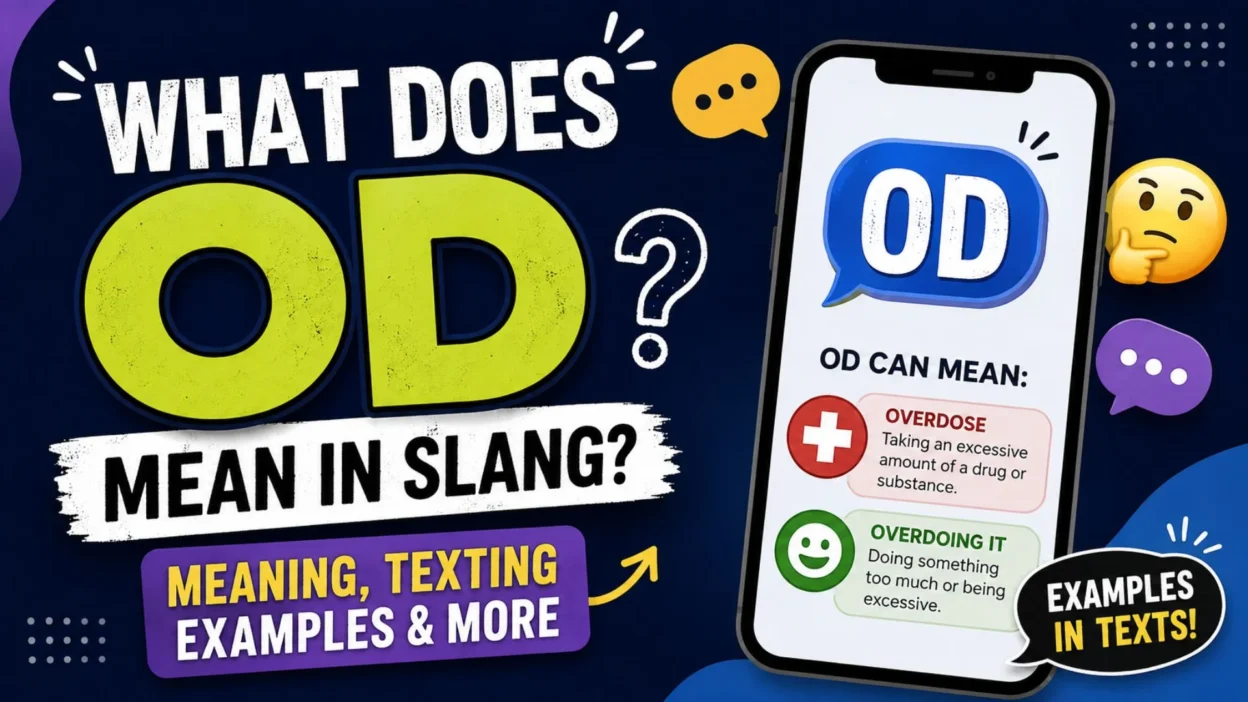
In casual conversations, OD often means “overdoing it” or “doing something excessively.” For example, if someone says, “You’re OD with those pictures,” they mean you’re posting too many pictures or taking things too far.
OD can also stand for “overdose,” especially when the conversation involves drugs, medication, or a serious health situation. Because these meanings are very different, looking at the surrounding conversation is important.
In this guide, we’ll explain what OD means in slang and texting, how people use it online, and give you simple examples so you can recognize its meaning quickly.
What Does OD Mean in Slang?
In slang, OD commonly means “overdoing it,” “too much,” or “excessive.” It can describe a person, action, reaction, or situation that seems to go beyond what is normal.
For example:
“You’re OD with the decorations.”
This means the person thinks the decorations are excessive or that the person has gone overboard.
OD can also be used as an intensifier:
“That movie was OD funny.”
Here, OD means extremely or very funny.
However, OD doesn’t always have this casual meaning. In certain contexts, it means overdose, so the surrounding words and situation matter.
What Does OD Mean in Texting?
When someone uses OD in a text message, it usually means one of two things:
- Overdoing it — taking something too far or doing too much
- Overdose — taking an excessive or dangerous amount of a substance
In casual texting, the first meaning is common.
For example:
Friend: “I bought five pairs of the same shoes.”
You: “Bro, you’re OD 😂”
Here, OD means the person is doing too much.
But consider a different conversation:
“He was taken to the hospital after an OD.”
In this case, OD refers to an overdose, not ordinary exaggeration.
That’s why you shouldn’t interpret OD based on the abbreviation alone.
OD Meaning: Overdoing Something
One of the most common slang uses of OD is to describe someone who is overdoing something.
It can mean:
- Doing too much
- Going overboard
- Being excessive
- Taking something too seriously
- Exaggerating
- Doing more than necessary
For example:
“You’re OD with the filters.”
This means someone is using too many filters on their pictures.
Another example is:
“She OD’d on the decorations for her birthday.”
The speaker means she went far beyond what was necessary with the decorations.
This use is especially common in casual conversations and social media.
OD Can Also Mean “Extremely”
Sometimes OD works more like an intensifier. Instead of literally meaning “overdoing,” it can add emphasis to another word.
For example:
“That pizza was OD good.”
This means the pizza was extremely good.
You might also see:
- “OD funny”
- “OD cute”
- “OD expensive”
- “OD hard”
- “OD easy”
- “OD annoying”
The exact interpretation depends on the sentence, but the general idea is very, extremely, or excessively.
OD Meaning: Overdose
The other major meaning of OD is overdose.
An overdose happens when someone takes too much of a substance, such as a medication or drug, and the amount can cause serious harm. The abbreviation “OD” is often used in medical, news, and everyday conversations to refer to an overdose.
For example:
“The news reported that he died after an OD.”
Here, OD clearly means overdose.
You may also encounter phrases such as:
- “drug OD”
- “accidental OD”
- “OD symptoms”
- “survived an OD”
- “died from an OD”
This meaning is more serious than the slang sense of “overdoing it.”
If OD appears in a conversation about drugs, medication, hospitalization, or someone’s health, overdose is likely the intended meaning.
How Can You Tell Which Meaning of OD Someone Means?
The easiest way to understand OD is to look at the context.
Ask yourself what the conversation is about.
If the conversation is casual
OD probably means overdoing something or extremely.
Example:
“You OD with those snacks.”
Meaning: You bought or ate way too many snacks.
If the conversation involves health or drugs
OD may mean overdose.
Example:
“He was hospitalized after an OD.”
Meaning: He experienced an overdose.
If OD describes an object or experience
It can mean very or extremely.
Example:
“That concert was OD amazing.”
Meaning: The concert was extremely amazing.
Context usually makes the intended meaning clear.
What Does OD Mean on Social Media?
On social media, OD is often used to describe something excessive or extremely good, funny, attractive, difficult, or impressive.
You may see it in comments, captions, replies, or private messages.
For example:
“This outfit is OD 🔥”
The person probably means the outfit looks extremely good.
Another example:
“You’re OD posting today.”
This suggests that someone is posting way too much.
You might also see:
“That video was OD funny.”
Here, OD adds emphasis and means really or extremely funny.
Because social media slang changes quickly, the exact meaning can vary between communities and regions.
OD Meaning on TikTok
On TikTok, OD can appear in comments and captions when users want to emphasize something.
For example:
“This transition is OD clean.”
The commenter means the transition looks extremely smooth or well done.
Or:
“Y’all are OD in these comments.”
This means the people commenting are doing too much, perhaps by exaggerating their reactions.
The same abbreviation can therefore have different meanings even on the same platform.
OD Meaning on Instagram and Snapchat
OD can also appear in Instagram comments, Snapchat messages, and other informal conversations.
Examples include:
“You’re OD pretty.”
Meaning: You’re extremely pretty.
“He OD posted his vacation.”
Meaning: He posted about his vacation excessively.
“That story was OD funny.”
Meaning: The story was extremely funny.
The tone is generally informal, so OD is better suited to texts, comments, and conversations with friends than formal writing.
Examples of OD in Text Messages
Here are some simple examples showing how people may use OD in everyday conversations:
Example 1:
“Bro, you OD bought snacks for this movie night.”
Meaning: You bought way too many snacks.
Example 2:
“That game was OD difficult.”
Meaning: The game was extremely difficult.
Example 3:
“Stop OD with the jokes 😂.”
Meaning: Stop going so far with the jokes.
Example 4:
“She was OD excited about the trip.”
Meaning: She was extremely excited.
Example 5:
“They said he suffered an OD.”
Meaning: They are referring to an overdose.
These examples show why context matters when interpreting the abbreviation.
Is OD a Positive or Negative Slang Word?
OD can be either positive or negative.
It depends on what you’re describing.
For example:
“That song is OD good.”
This is positive because the speaker thinks the song is extremely good.
But:
“You’re OD annoying today.”
This is negative because the person feels someone is being excessively annoying.
It can also be neutral:
“He OD packed for a two-day trip.”
This simply suggests that he packed far more than necessary.
So, OD doesn’t automatically carry a positive or negative meaning.
OD vs. “Doing Too Much”
The slang meaning of OD is closely related to phrases such as:
- Doing too much
- Going overboard
- Going over the top
- Being extra
- Taking it too far
- Being excessive
For example:
“You’re doing too much.”
and
“You’re OD.”
can communicate a similar idea in an informal conversation.
The difference is mostly in style and tone. OD is shorter and more slang-oriented.
Is OD the Same as “Overdose”?
Not always.
OD can be an abbreviation for overdose, but slang users also use OD to mean overdoing something or being excessive.
Compare these two sentences:
“He OD’d on medication.”
Here, OD means overdosed.
“He OD’d with the decorations.”
Here, OD’d means overdid it.
The spelling is similar, but the meanings are completely different.
That’s why reading the entire sentence is important.
Is OD Appropriate in Formal Writing?
Generally, OD is best avoided in formal writing unless you’re specifically discussing the abbreviation itself.
In a professional email, school assignment, report, or formal article, it is usually clearer to write the full phrase.
For example, instead of:
“The patient experienced an OD.”
a formal medical context may require the specific term overdose.
Likewise, instead of saying:
“He OD on the presentation.”
in formal writing, you could say:
“He went overboard with the presentation.”
Slang is most natural in informal conversations, texts, comments, and social media.
Common Slang Words Similar to OD
If someone uses OD to mean “too much” or “excessive,” several other slang expressions may communicate a similar idea.
Extra
“Extra” describes someone or something that is overly dramatic or excessive.
“She’s being extra today.”
Overboard
Going overboard means taking something too far.
“He went overboard with the decorations.”
Doing Too Much
This is a straightforward way to say someone is being excessive.
“You’re doing too much with that outfit.”
Too Much
This simple phrase can also express the same idea.
“That’s too much for one party.”
Excessive
This is a more formal alternative to OD.
“The amount of food was excessive.”
These expressions can help you understand the general idea behind OD when it’s being used casually.
Quick Guide to OD Meaning
| Context | Likely Meaning |
|---|---|
| “You’re OD” | You’re doing too much |
| “OD funny” | Extremely funny |
| “OD expensive” | Extremely expensive |
| “OD with the filters” | Overdoing the filters |
| “He had an OD” | Overdose |
| “OD on medication” | Overdose |
| “That outfit is OD” | Extremely good/impressive, depending on context |
FAQs About OD Meaning
What does OD mean in slang?
In slang, OD commonly means “overdoing it,” “doing too much,” or “extremely.” In other contexts, it can mean “overdose.”
What does OD mean in texting?
In texting, OD often means overdoing something or being excessive. For example, “You’re OD” can mean “You’re doing too much.”
What does OD mean on social media?
On social media, OD can mean extremely or too much, depending on the sentence. “OD funny” means extremely funny, while “You’re OD posting” means you’re posting too much.
Does OD always mean overdose?
No. Although OD is commonly used as an abbreviation for overdose, slang users also use it to mean overdoing something or being excessive.
What does “ODing” mean?
“ODing” can mean overdoing something in casual slang. However, in a health-related context, it can mean overdosing.
Is “OD” positive or negative?
It can be either. “OD good” is positive, while “OD annoying” is negative. The meaning depends on the word or situation around it.
Can I use OD in a formal message?
It’s better to avoid slang like OD in formal communication. Use clearer words such as extremely, excessive, overdoing it, or overdose, depending on what you mean.
What does “OD” mean in New York slang?
In New York and other urban slang communities, OD is commonly used to express excessiveness or intensity, such as “OD funny” for extremely funny or “You’re OD” for doing too much.
Final Thoughts
So, what does OD mean in slang? Most often, it means overdoing something, doing too much, or being extremely something. For example, “That movie was OD funny” means the movie was extremely funny.
However, OD can also mean overdose, especially when the conversation involves drugs, medication, or a medical situation. That’s why context is the key to understanding this abbreviation.
If you see OD in a casual text or social media comment, look at the words around it before deciding what it means. Once you know the context, the intended meaning is usually easy to figure out.

hwuduwgdul