
Last Updated: May 18, 2026
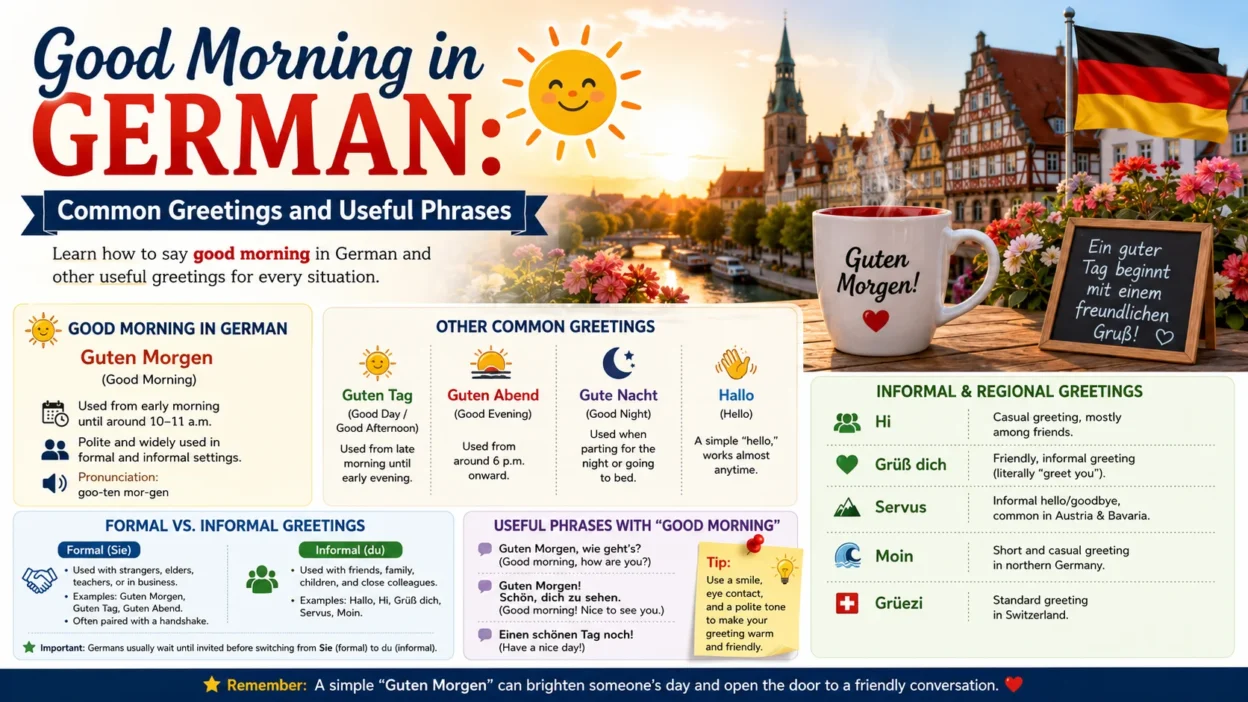
Learning how to say good morning in German is one of the first and most useful skills when you start studying the language. Greetings are not just words—they’re part of German culture, showing respect, friendliness, and sometimes even regional identity. Whether you’re meeting someone for the first time, chatting with friends, or practicing for your Goethe-Institut exam, knowing the right greeting makes a big difference.
If you’ve ever asked yourself, “How do you say good morning in German?” or searched for “good morning in German language” , this guide will answer all your questions. We’ll even cover “good morning in deutsch” — which simply means “good morning in German” — and explain “Guten Morgen is which language” (spoiler: it’s German).
In this guide, we’ll explore good morning in German, along with other greetings for different times of day, formal and informal situations, and regional variations across Germany, Austria, and Switzerland.
What is Good Morning in German?
If you’ve searched for “what is good morning in german”, the answer is simple:
Guten Morgen
This is the standard, most common way to say good morning in German. It’s polite, widely understood, and appropriate in almost any situation — from formal business meetings to casual conversations with friends.
Good Morning in German Language: Pronunciation Guide
For those searching “german language good morning” or “german of good morning”, pronunciation is key. Here’s how to say Guten Morgen correctly:
| German Word | Pronunciation (Phonetic) | English Sound |
|---|---|---|
| Guten | [ˈɡuːtən] | “GOO-ten” (soft ‘n’) |
| Morgen | [ˈmɔʁɡn̩] | “MOR-gen” (guttural ‘r’) |
Quick tip: The German ‘r’ is pronounced in the back of the throat — similar to a soft gargle. Don’t worry if it’s not perfect at first; Germans will still understand you!
How Do You Say Good Morning in German? (Formal & Informal)
Many learners ask “how do you say good morning in german” and also want to know the difference between formal and informal versions.
Formal Good Morning in German
Use this with:
- Strangers
- Elders
- Teachers
- Bosses and colleagues (unless you’re close friends)
- Shopkeepers and service staff
Guten Morgen — Good morning
Informal Good Morning in German
If you’ve searched for “good morning in german informal”, here are your options:
| Informal Greeting | Meaning | When to Use |
|---|---|---|
| Morgen! | Morning! (shortened) | Friends, family, close colleagues |
| Hallo am Morgen | Hello in the morning | Casual, friendly |
| Moin | Hi / Good morning | Northern Germany, any time of day |
| Servus | Hello / Goodbye | Austria & Bavaria, informal |
Example:
- Informal: “Morgen! Wie geht’s?” — Morning! How’s it going?
- Formal: “Guten Morgen. Wie geht es Ihnen?” — Good morning. How are you? (formal)
Good Morning, How Are You in German
A very common search is “good morning how are you in german”. Here’s how to combine both phrases naturally:
Informal (to friends, family, children)
Guten Morgen! Wie geht es dir?
Good morning! How are you? (informal)
Or shorter:
Morgen! Wie geht’s?
Morning! How’s it going?
Formal (to strangers, bosses, elders)
Guten Morgen! Wie geht es Ihnen?
Good morning! How are you? (formal)
Other variations:
- Guten Morgen! Alles gut? — Good morning! Everything good?
- Guten Morgen! Wie läuft’s? — Good morning! How’s it going? (casual)
- Guten Morgen! Aufgewacht? — Good morning! Awake yet? (playful)
Romantic Good Morning Message in German ❤️
One of your special requests is “romantic good morning message in german”. While this is a less common search, it’s a beautiful way to surprise a German-speaking partner. Here are some romantic Guten Morgen messages:
Sweet & Simple
| German | English |
|---|---|
| Guten Morgen, mein Schatz. | Good morning, my treasure. |
| Guten Morgen, mein Liebling. | Good morning, my darling. |
| Guten Morgen, meine schöne Liebe. | Good morning, my beautiful love. |
Poetic & Romantic
Ich wachte auf und dachte sofort an dich. Guten Morgen!
I woke up and thought of you immediately. Good morning!
Ein Lächeln von dir am Morgen ist besser als Kaffee. Guten Morgen!
A smile from you in the morning is better than coffee. Good morning!
Deine Liebe ist mein Sonnenschein am Morgen. Guten Morgen, mein Herz.
Your love is my sunshine in the morning. Good morning, my heart.
Jeder Morgen mit dir ist ein Geschenk. Ich liebe dich.
Every morning with you is a gift. I love you.
You can send these as texts, write them in a card, or whisper them to your partner when they wake up.
Good Morning in Germany: Cultural Context
When people search for “good morning in germany” or “good morning germany”, they often want to understand the cultural rules. Here’s what you need to know:
When to Say Guten Morgen
- From sunrise until approximately 10:00 AM – 11:00 AM
- After 11 AM, switch to Guten Tag (Good day/afternoon)
German Greeting Etiquette
- ✅ Always make eye contact when greeting
- ✅ Offer a firm handshake in formal situations
- ✅ Say Guten Morgen to everyone in a small room (waiting room, elevator, shop)
- ❌ Don’t hug or kiss cheeks unless you’re close friends
- ❌ Don’t say “Gute Nacht” as a greeting — it’s only for bedtime
What is Morning in German?
Many learners search for “morning in german”. The word for “morning” is der Morgen.
Useful Phrases with “Morgen”
| German Phrase | English Meaning |
|---|---|
| am Morgen | in the morning |
| heute Morgen | this morning |
| jeden Morgen | every morning |
| früher Morgen | early morning |
| Morgenstunde | morning hour |
Famous German Proverb
Morgenstund hat Gold im Mund.
The morning hour has gold in its mouth.
(Equivalent to: “The early bird catches the worm.”)
Important note: Morgen can also mean “tomorrow” depending on context. For example:
- Guten Morgen = Good morning
- Bis morgen = See you tomorrow
German Good Morning: Regional Variations
If you’ve searched for “german good morning” or “good morning german”, you might not realize that German greetings vary by region. Here are the most important regional variations:
Northern Germany: Moin 🌊
- Used all day, not just morning
- Very common in Hamburg, Bremen, Kiel, and coastal areas
- Origin: From Morgen but also from Low German moi meaning “nice”
- Example: Moin Moin! — Extra friendly version
Southern Germany & Austria: Grüß Gott and Servus 🏔️
- Grüß Gott — “God bless you” (polite, traditional)
- Servus — Informal hello/goodbye (very common in Bavaria and Austria)
- Example: Servus, wie geht’s? — Hello, how are you?
Switzerland: Grüezi 🇨🇭
- Standard greeting in Swiss German
- Formal and polite
- Example: Grüezi mitenand — Hello everyone
Berlin & Surroundings: Tach!
- Short, casual version of Guten Tag
- Often used in the morning as well
- Example: Tach auch! — Hello to you too!
Good Morning in Deutsch: Common Mistakes to Avoid
When people search for “good morning in deutsch”, they sometimes make these common errors:
❌ Wrong: Guten Morgan
✅ Correct: Guten Morgen
❌ Wrong: Good Morgen (mixing English and German)
✅ Correct: Guten Morgen
❌ Wrong: Goodmorning in german (as one word)
✅ Correct: Guten Morgen (two words)
❌ Wrong: Saying “Gute Nacht” when arriving somewhere in the evening
✅ Correct: Use “Guten Abend” for evening arrival
❌ Wrong: Using “du” (informal) with a stranger
✅ Correct: Use “Sie” (formal) unless invited otherwise
The phrase “german for good morning” is simply “Guten Morgen” — the most common and standard way to say good morning in the German language.
Guten Morgen is Which Language?
This is a fun question that people search for: “guten morgen is which language”.
Answer: German 🇩🇪
Guten Morgen is standard German (Hochdeutsch). However, similar phrases exist in other Germanic languages:
| Language | Phrase | Meaning |
|---|---|---|
| German | Guten Morgen | Good morning |
| Dutch | Goedemorgen | Good morning |
| Swedish | God morgon | Good morning |
| Danish | God morgen | Good morning |
| Yiddish | Gut morgn | Good morning |
So if you hear Guten Morgen, you’re definitely hearing German!
German Greetings for Every Time of Day
| English | German | When to Use |
|---|---|---|
| Good morning | Guten Morgen | Sunrise – 11 AM |
| Good day / Afternoon | Guten Tag | 11 AM – 6 PM |
| Good evening | Guten Abend | 6 PM – bedtime |
| Good night | Gute Nacht | Before bed (farewell only) |
| Hello | Hallo | Any time, informal |
| Hi | Hi | Casual, with friends |
| Greetings | Grüß Gott | Southern Germany, Austria |
| Hello (North) | Moin | Northern Germany, any time |
| Hello (Swiss) | Grüezi | Switzerland |
Frequently Asked Questions (FAQs)
Q1: What is the most common way to say good morning in German?
A: The most common and polite way is Guten Morgen. It works in formal and informal situations.
Q2: Can I just say “Morgen” instead of “Guten Morgen”?
A: Yes! Morgen! (shortened) is very common among friends, family, and close colleagues. However, avoid using it with strangers or in formal settings.
Q3: How do you say “good morning beautiful” in German?
A: Guten Morgen, meine Schöne (to a woman) or Guten Morgen, mein Schöner (to a man). For a romantic partner: Guten Morgen, mein Schatz (my treasure).
Q4: Is “Gute Nacht” the same as “Good night” in English?
A: Mostly yes, but with one important difference: In English, you can say “Good night” when arriving somewhere in the evening. In German, Gute Nacht is only for farewells or before bed. For evening arrivals, say Guten Abend.
Q5: What’s the difference between “Guten Morgen” and “Moin”?
A: Guten Morgen is standard German and can be used anywhere. Moin is a regional greeting from northern Germany that can be used any time of day (not just morning).
Q6: How do you respond to “Guten Morgen”?
A: Simply say Guten Morgen back. You can also add Wie geht es dir? (informal) or Wie geht es Ihnen? (formal) to ask how they are.
Q7: Do Germans say “Good morning” after 11 AM?
A: No. After 11 AM, Germans typically switch to Guten Tag (good day/afternoon). Saying Guten Morgen at 1 PM would sound strange.
Q8: Is it rude not to say “Guten Morgen” in Germany?
A: In small settings (e.g., entering a waiting room, a small shop, or an elevator), it’s considered polite to greet everyone with a simple Guten Morgen. Skipping it can be seen as rude or cold.
Q9: How do you say “good morning teacher” in German?
A: Guten Morgen, Herr Lehrer (male teacher) or Guten Morgen, Frau Lehrerin (female teacher). In formal settings, use their last name: Guten Morgen, Herr Schmidt.
Q10: Can I use “Guten Morgen” in Switzerland or Austria?
A: Yes, everyone will understand you. However, locals might respond with Grüezi (Switzerland) or Servus / Grüß Gott (Austria). It’s a nice touch to learn the local greeting too!
Learn More & Keep Practising 📘
If you want to get better at greetings and conversations in German:
- ✅ Practice daily by greeting friends, family, or even yourself in German
- ✅ Use apps like Duolingo, Babbel, or Memrise to repeat greetings in context
- ✅ Watch German shows or listen to podcasts to hear greetings in action
- ✅ Consider taking a German tutor class or online course
- ✅ Prepare for Goethe-Zertifikat exams by learning how to introduce yourself properly
The more you practice, the more natural your greetings will feel.
Final Conclusion
Learning how to say good morning in German is more than just picking up a new phrase — it’s about understanding the culture, respect, and warmth behind every greeting. Whether you say Guten Morgen, Grüß Gott, or Moin, each expression reflects regional charm and social etiquette.
By mastering formal and informal greetings — including good morning in German informal variations — and even learning a romantic good morning message in German, you can confidently connect with people across Germany, Austria, and Switzerland.
So next time you greet someone, remember that a simple Guten Morgen can do more than start a conversation — it can build trust, show respect, and brighten someone’s day.
Guten Morgen, und einen schönen Tag! 🌞
(Good morning, and have a beautiful day!)

Grace is a lifestyle writer from California who loves starting mornings with positivity. At Mornetic, she shares uplifting quotes and cheerful messages to brighten your day.