Last updated: May 15, 2026
Saying “good morning” is one of the simplest ways to connect with people, but learning how to say good morning in different languages can make your greetings even more meaningful. From “Bonjour” in France to “Ohayō Gozaimasu” in Japan, morning greetings reflect culture, respect, and everyday communication around the world. Many travelers, students, and language learners enjoy discovering good morning in other languages to build stronger connections and better understand global traditions.
In this complete guide, you’ll learn how to say good morning in different languages, including popular European, Asian, African, and Middle Eastern greetings. We’ll also cover pronunciation tips, cultural meanings, and useful phrases to help you confidently greet people from different countries. Whether you are traveling, learning a new language, or simply curious about global cultures, these multilingual morning greetings will help you communicate in a more friendly and respectful way.
The Art of the Morning Greeting: Why It Matters
A morning greeting is a universal sign of acknowledgment and goodwill. It’s a small but significant social ritual. Using a local greeting shows that you’ve made an effort, bridging gaps and fostering immediate camaraderie. In business, it can be the difference between a cold meeting and a warm, productive one. While a simple “hello” often works, using the specific morning greeting demonstrates a deeper level of cultural awareness and respect. It tells the person you are engaging with that you see and value their background.
A Guide to Pronunciation Help
Before we dive in, let’s decode the pronunciation key used in this article:
- Syllables in bold indicate where the stress should be.
- We’ll use intuitive, phonetic spellings to make it easy for English speakers.
European Good Morning Greetings
Europe is a tapestry of languages, and its morning greetings are just as diverse. Here’s how to say good morning in some of the most spoken European languages.
Spanish: Buenos Días
- Pronunciation: Bweh-nohs Dee-ahs
- Cultural Note: In Spain and Latin America, this is the standard formal greeting until around noon. It’s often accompanied by a kiss on the cheek (in Spain) or a warm handshake.
French: Bonjour
- Pronunciation: Bohn-zhoor
- Cultural Note: “Bonjour” is essential for every interaction in France. It’s considered polite to say it when you enter a shop or greet anyone, even strangers in a lift.
Italian: Buongiorno
- Pronunciation: Bwohn-jor-noh
- Cultural Note: This greeting is used formally and informally until the early afternoon. Italians are known for their warmth, so pair it with a smile!
German: Guten Morgen
- Pronunciation: Goo-ten Mor-gen
- Cultural Note: Germans appreciate punctuality and directness, and a clear “Guten Morgen” is a perfect, polite way to start the day.
Portuguese: Bom Dia
- Pronunciation: Bong Dee-ah
- Cultural Note: Used in both Portugal and Brazil, “Bom Dia” is a cheerful and common greeting. The pronunciation in Brazil is often slightly softer.
Dutch: Goedemorgen
- Pronunciation: Khoo-duh-mawr-ghun
- Cultural Note: The Dutch are generally direct and open. A “Goedemorgen” is a straightforward and friendly way to acknowledge someone.
Russian: Доброе утро (Dobroye utro)
- Pronunciation: Dob-ruh-ye oo-truh
- Cultural Note: This is the standard morning greeting. Remember to use the formal “Vy” (you) with people you don’t know well, paired with their first name and patronymic.
Swedish: God morgon
- Pronunciation: Good mor-ron
- Cultural Note: Swedes often value a calm and reserved demeanor. A simple “God morgon” with a nod is a perfectly appropriate greeting.
Asian Good Morning Greetings
Asia’s linguistic landscape is incredibly rich. Greetings here often involve different levels of formality and can include gestures.
Mandarin Chinese: 早上好 (Zǎoshang hǎo)
- Pronunciation: Zow-shahng how
- Cultural Note: This is a standard, polite greeting. A more informal version is simply “早 (Zǎo)!”. Bowing is not typically part of everyday greetings in modern China; a nod or smile is common.
Japanese: おはようございます (Ohayō gozaimasu)
- Pronunciation: Oh-hai-yo go-zai-mas
- Cultural Note: The formal version is “Ohayō gozaimasu.” With close friends and family, you can shorten it to “Ohayō!”. A bow often accompanies the greeting, with the depth depending on the formality of the situation.
Korean: 좋은 아침이에요 (Joeun achimieyo)
- Pronunciation: Joh-oon ah-cheem-ee-eh-yo
- Cultural Note: This is a modern, commonly used phrase. An even more informal version is simply “안녕 (Annyeong)!”, which means “hello.” A slight bow is a common and respectful gesture.
Hindi: नमस्ते (Namaste) / शुभ प्रभात (Shubh Prabhaat)
- Pronunciation: Nuh-muh-stay / Shubh Pruh-bhaat
- Cultural Note: “Namaste” (with hands pressed together near the chest) is a universal greeting used at any time. “Shubh Prabhaat” is a more literal “good morning” but is less commonly used in casual conversation.
Arabic: صباح الخير (Sabah al-khair)
- Pronunciation: Sah-bah al-khair
- Cultural Note: This is the standard greeting in the morning across the Arab world. The response is “صباح النور (Sabah an-nur)” meaning “light of the morning.” It is used in both formal and informal settings.
African Good Morning Greetings
Africa is home to over a thousand languages. Here are greetings from some of the most widely spoken ones.
Swahili: Habari za asubuhi
- Pronunciation: Hah-bah-ree zah ah-soo-boo-hee
- Cultural Note: Swahili is a lingua franca in East Africa. “Habari” means “news,” so you are essentially asking, “What’s the news of the morning?” A common response is “Nzuri” (good).
Amharic: እንደምን አደርክ (Endemen aderk?)
- Pronunciation: En-dem-en ah-derk (to a male)
- Cultural Note: This greeting is a question meaning “How did you spend the night?” It demonstrates a deep level of care and interest in the other person’s well-being.
Yoruba: Ẹ káàrọ̀
- Pronunciation: Eh kah-roh
- Cultural Note: The “Ẹ” denotes respect. When greeting an elder or someone in a position of authority, this formal version is essential. To a peer, you could use “Ẹ káàrọ̀” or a more casual “Káàrọ̀.”
Zulu: Sawubona
- Pronunciation: Sah-woo-boh-nah
- Cultural Note: “Sawubona” literally means “I see you,” acknowledging the other person’s presence and humanity. It is used at any time of day, not just the morning.
Greetings from Down Under & The Pacific
The languages of Oceania offer unique and beautiful ways to start the day.
Hawaiian: Aloha kakahiaka
- Pronunciation: Ah-loh-hah kah-kah-hee-ah-kah
- Cultural Note: “Aloha” is more than a greeting; it carries meanings of love, peace, and compassion. “Aloha kakahiaka” is a warm, heartfelt way to wish someone a good morning.
Māori: Ata mārie
- Pronunciation: Ah-tah maa-ree-eh
- Cultural Note: This is a peaceful and calm greeting, literally wishing someone a “calm morning.” The Māori language (te reo Māori) is experiencing a vibrant revival in New Zealand.
Australian Aboriginal English: G’day
- Pronunciation: Guh-day
- Cultural Note: While “G’day” is a classic Australian greeting used at any time, it’s a quintessential part of the morning lexicon. It’s informal, friendly, and iconic.
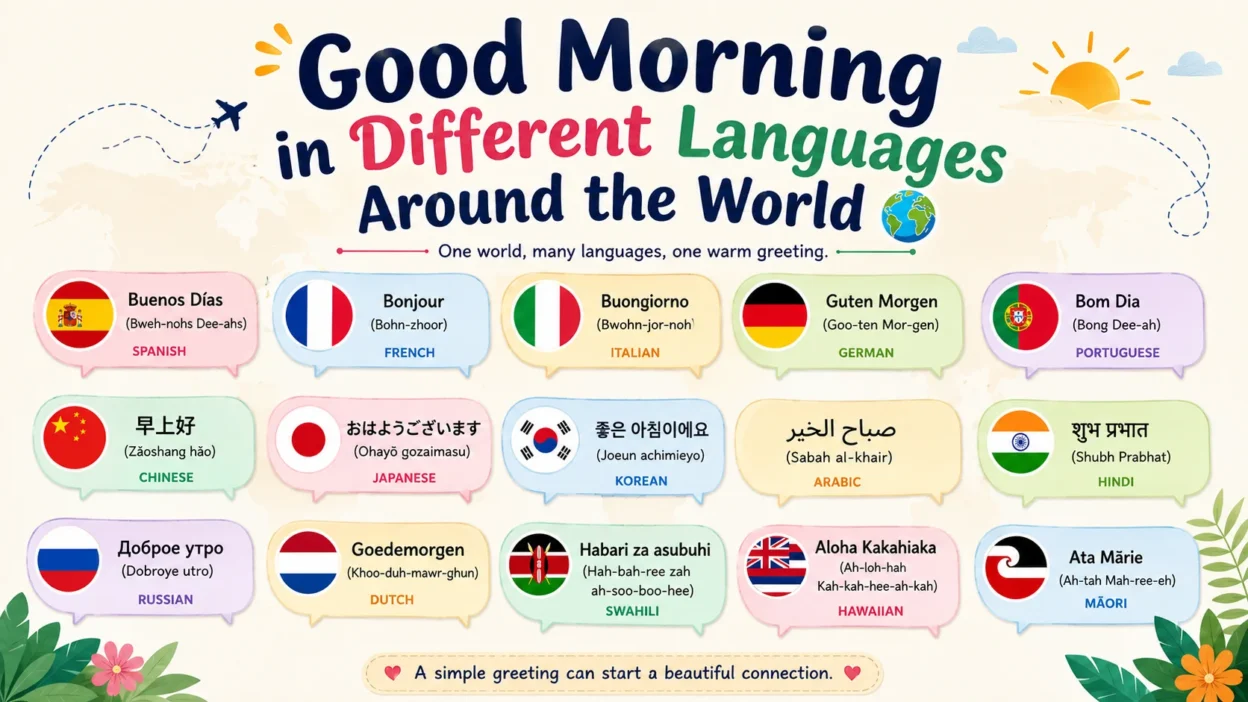
Good Morning in Different Languages Around the World
- Buenos Días (Spanish)
- Bonjour (French)
- Buongiorno (Italian)
- Guten Morgen (German)
- Bom Dia (Portuguese)
- Goedemorgen (Dutch)
- Dobroye Utro (Russian)
- Zǎoshang Hǎo (Chinese)
- Ohayō Gozaimasu (Japanese)
- Joeun Achimieyo (Korean)
- Sabah Al-Khair (Arabic)
- Namaste / Shubh Prabhat (Hindi)
- Habari Za Asubuhi (Swahili)
- Aloha Kakahiaka (Hawaiian)
- Ata Mārie (Māori)
How to Say Good Morning in Different Languages
- Good morning in Spanish — Buenos Días
- Good morning in French — Bonjour
- Good morning in Italian — Buongiorno
- Good morning in German — Guten Morgen
- Good morning in Japanese — Ohayō Gozaimasu
- Good morning in Korean — Joeun Achimieyo
- Good morning in Chinese — Zǎoshang Hǎo
- Good morning in Arabic — Sabah Al-Khair
- Good morning in Hindi — Shubh Prabhat
- Good morning in Portuguese — Bom Dia
- Good morning in Russian — Dobroye Utro
- Good morning in Dutch — Goedemorgen
- Good morning in Swahili — Habari Za Asubuhi
- Good morning in Hawaiian — Aloha Kakahiaka
- Good morning in Māori — Ata Mārie
Good Morning in Foreign Languages with English Translation
- Bonjour — Good Morning (French)
- Buenos Días — Good Morning (Spanish)
- Guten Morgen — Good Morning (German)
- Buongiorno — Good Morning (Italian)
- Bom Dia — Good Morning (Portuguese)
- Ohayō — Good Morning (Japanese)
- Zǎo — Morning / Good Morning (Chinese)
- Annyeong — Hello / Morning Greeting (Korean)
- Sabah Al-Khair — Morning of Goodness (Arabic)
- Namaste — Greetings / Respectful Hello (Hindi)
- Sawubona — I See You (Zulu)
- Aloha — Love / Hello / Good Morning (Hawaiian)
- Ata Mārie — Peaceful Morning (Māori)
- Dobroye Utro — Good Morning (Russian)
- Goedemorgen — Good Morning (Dutch)
Morning Greetings in Different Languages for Travelers
- French greeting for tourists — Bonjour
- Japanese polite greeting — Ohayō Gozaimasu
- Korean morning phrase — Joeun Achimieyo
- Arabic morning greeting — Sabah Al-Khair
- Italian travel greeting — Buongiorno
- German formal greeting — Guten Morgen
- Portuguese local greeting — Bom Dia
- Spanish everyday greeting — Buenos Días
- Chinese morning phrase — Zǎoshang Hǎo
- Hindi respectful greeting — Namaste
- Swahili East African greeting — Habari Za Asubuhi
- Russian formal morning greeting — Dobroye Utro
- Hawaiian island greeting — Aloha Kakahiaka
- Māori traditional greeting — Ata Mārie
- Dutch common greeting — Goedemorgen\
- Many travelers love learning how to say good morning in other languages to connect with people from different cultures more respectfully.
- Exploring good morning different languages greetings is a fun way to understand global traditions, pronunciation, and cultural communication styles.
How to Master the Pronunciation 🎯
Feeling overwhelmed? Don’t be! Here are some proven tips to help you get the pronunciations right.
- 🗣️ Use Technology: Google Translate’s audio feature is a great starting point.
- 🎧 Listen Actively: Watch travel vlogs or listen to language podcasts to hear native speakers.
- 📱 Try Language Apps: Apps like Duolingo, Memrise, or Pimsleur offer pronunciation practice.
- 👄 Break It Down: Practice one syllable at a time, then slowly combine them.
- 🙊 Don’t Fear Mistakes: Native speakers almost always appreciate the effort, even if your accent isn’t perfect.
Cultural Etiquette: Beyond the Words
Saying the words correctly is only half the battle. Understanding the accompanying body language and social context is crucial.
- 🇯🇵 Bowing in Japan: The depth and duration of the bow matter. A small nod is casual, while a deeper bow shows respect.
- 🇮🇳 The Namaste in India: Pressing your palms together at the chest is a sign of respect. The higher the hands, the greater the respect.
- 🇫🇷 La Bise in France: The cheek kiss greeting varies by region—anywhere from one to four kisses! In a professional setting, a handshake is safer.
- 🇹🇭 The Wai in Thailand: A slight bow with the palms pressed together is called a “wai.” The height of your hands and the depth of the bow indicate the level of respect.
The Power of a Simple Morning Greeting in Today’s Global World
In today’s fast-paced digital world, simple human connections matter more than ever. Learning how to say “good morning” in different languages is not just about words — it’s a meaningful way to show respect, kindness, and cultural awareness. A thoughtful greeting can instantly create a warm connection, whether you are traveling, working with international teams, learning a new language, or meeting people from different cultures.
Using local morning greetings helps break communication barriers and makes conversations feel more personal and genuine. From saying “Bonjour” in France to “Ohayō Gozaimasu” in Japan, these small phrases can leave a positive impression and help you connect with people around the world in a friendly and respectful way.
Frequently Asked Questions About Good Morning in Different Languages
How do you say good morning in different languages?
People say good morning differently around the world, such as “Buenos Días” in Spanish, “Bonjour” in French, “Guten Morgen” in German, and “Ohayō Gozaimasu” in Japanese.
What is good morning in all languages?
Good morning has unique translations in every language. Some popular examples include “Bom Dia” in Portuguese, “Buongiorno” in Italian, “Sabah Al-Khair” in Arabic, and “Zǎoshang Hǎo” in Chinese.
What are some common good morning greetings in foreign languages?
Some common foreign language greetings are Bonjour (French), Buenos Días (Spanish), Guten Morgen (German), Namaste (Hindi), and Aloha Kakahiaka (Hawaiian).
How can I translate good morning into other languages?
You can translate “good morning” using language apps, online translators, dictionaries, or multilingual greeting guides that provide pronunciation and cultural context.
How do you say good morning in various languages correctly?
The best way to say good morning correctly in various languages is by learning pronunciation from native speakers, language apps, or pronunciation guides.
Why is learning good morning in different languages useful?
Learning multilingual greetings helps travelers, students, and professionals communicate respectfully and build stronger connections with people from different cultures.
What is the easiest way to learn morning greetings in different languages?
The easiest way is to practice a few greetings daily, listen to native pronunciation, use flashcards, and repeat phrases aloud during conversations.
What are the most popular good morning greetings around the world?
Popular greetings include Bonjour (French), Buenos Días (Spanish), Buongiorno (Italian), Guten Morgen (German), and Ohayō Gozaimasu (Japanese).
How do travelers use good morning greetings in other languages?
Travelers often use local greetings to show politeness, respect local culture, and create friendly interactions with native speakers during trips.
Can learning morning greetings improve communication skills?
Yes, learning greetings in different languages improves cultural awareness, communication confidence, pronunciation skills, and social interactions worldwide.
Conclusion
Learning how to say “good morning” in different languages is a simple yet meaningful way to connect with people from around the world. From “Bonjour” in French to “Ohayō Gozaimasu” in Japanese, every greeting reflects the culture, traditions, and communication style of a country. These small phrases can help travelers, students, and professionals create stronger relationships and show respect in international conversations.
By practicing good morning greetings in various languages, you not only improve your language skills but also gain a deeper appreciation for global cultures and traditions. Whether you are traveling, studying a new language, or simply curious about the world, learning multilingual greetings is a fun and valuable step toward better communication and cultural understanding.

Grace is a lifestyle writer from California who loves starting mornings with positivity. At Mornetic, she shares uplifting quotes and cheerful messages to brighten your day.